Thursday, 23 June 2011

An Intermission


I’ve got some demanding, but extremely welcome, new personal commitments at the moment which, combined with preparation for the second semester next month, mean I won’t be posting on here for a while.

It came as a surprise, preparing this, to realise I’ve been writing this blog for over a year now. The Tokyo autumn of those first posts seems a lifetime away, but the habit of writing – and thinking aloud – in public is one I’m only just getting comfortable with exploring properly. Thank you all for your comments and suggestions, both here and via email and elsewhere. Google Analytics tells me that most of you who read here regularly are family members, friends, and comrades; I’ve made some new friends along the way, too, and I value all of your input.

The pleasure, for me, is, in particular, to do with the blurring of roles blogging encourages. I’m writing as a conscious socialist and an activist, but also as someone within – and committed to – the humanities, hoping that the internet might give us ways to connect research in the humanities with interested readers and thinkers outside the university, and to share ideas and reading more widely. And, of course, as most of you will realise too, I’m a student still most of the time: these pieces are really records of other’s research, other’s thinking, other histories, and what I can learn from them. I hope you've been able to learn something to along the way. I know I have from you.

I hope to start posting again towards the end of next month.

皆様、大変ありがとうございました。つぎはもとがんばります。

A Poet's Welcome to his Love-Begotten Daughter: the First Instance that Entitled Him to the Venerable Appellation of Father

Thou's welcome, wean! Mishanter fa' me
If thoughts o' thee, or yet thy Mamie,
Shall ever daunton me or awe me,
My bonnie lady,
Or if I blush when thou shalt ca'me
Tyta, or Daddie!

Tho' now they ca' me fornicator,
And tease my name in kintra clatter,
The mair they talk, I'm kend the better;
E'en let them clash!
An auld wife's tongue's a feckless matter
To gie ane fash!

Welcome, my bonnie, sweet, wee dochter!
Tho' ye came here a wee unsought for.
And tho' your comin I hae fought for
Baith Kirk and Queir,
Yet by my faith, ye're no unwrought for,
That I shall swear.

Wee image o' my bonnie Betty,
As fatherly I kiss and daut thee,
As dear and near my heart I set thee,
Wi' as guide will
As a' the priests had seen me get thee
That's out o'Hell!

Sweet fruit o' mony a merry dint,
My funny toil is no a' tint;
Tho' ye come to the world askent,
Which fools may scoff at,
In my last plack your part's be in't,
The better half o't.

Tho I should be the waur bestead,
Thou's be as braw and bienly clad,
And thy young years as nicely bred
Wi' education,
As ony brat o' wedlock's bed,
In a' thy station.

Lord grant that thou may aye inherit
Thy mither's person, grace and merit,
An' thy poor worthless daddy's spirit
Without his failins,
'Twill please me mair to see thee inherit
Than stockit mailens.

For if thou be, what I would hae thee,
And tak the counsel I shall gie thee,
I'll never rue my trouble wi' thee,
The cost nor shame on't,
But be a loving Father to thee,
And brag the name o't!

Monday, 6 June 2011

An Actor's Revenge


The frustration that thinking about adaptation induces is closely aligned to its temptations. Whatever the rigour of your training in literary or film studies it’s likely that, in unguarded moments, you’re to be found making comments on a film’s faithfulness or value compared to its ‘original’ and source. At the same time, though, without resurrecting some sort of full-blown structuralist model to account for the ‘deep structure’ of story-units behind this or that particular instance of narration (and, I know, none of you want that), it’s hard to get a sense of just how this faithfulness so-called might ever be practiced. The difficulty is compounded when you try on Dudley Andrew’s famous terms - adaptation as borrowing, intersecting or transforming - for conceptual sizing: even to find the terms with which one might distinguish the one from the other is a task which feels as difficult as it does hopeless. Adaptation is such a dominant practice in film production today that to ignore it - or consign the kind of questions viewers ask when traveling under the sign of fidelity to theoretical irrelevancy - seems self-defeating. What move to make next is far from obvious; if, though, like me, you’re drawn to these moments of translation and adaptation, there’s little choice but to let the worrying take hold.

Two stimulating bundles of thought suggest ways out of this dilemma. A recent piece by Dudley Andrew on the “economies of adaptation” offers an image of adaptation as energy, productivity:

Adaptation may be the humming motor of uncontrollable textual proliferation - the horizational spread of a title, an author, an idea from medium to medium, language to language - but it can also function as an antidote or alternative. For if the vertical line that anchors it to the bedrock of its source remains intact, a contemporary film can draw away from the system, submerging its audience in a different sensibility and set of values. That chain bears the troubled name ‘fidelity.’ (32)

Andre Bazin, over sixty years ago, offered a way to read film adaptation as “digest”, with far-reaching, and still underdeveloped theoretical consequences:

All things considered, it’s possible to imagine that we are moving toward a reign of the adaptation in which the notion of the unity of the work of art, if not the very notion of the author himself, will be destroyed. If the film that was made of Steinbeck’s Of Mice and Men (1940; dir. Lewis Milestone) had been successful (it could have been so, and far more easily than the adaptation of the same author’s Grapes of Wrath), the (literary?) critic of the year 2050 would find not a novel out of which a play and a film had been ‘made’, but rather a single work reflected through three art forms, an artistic pyramid with three sides, all equal in the eyes of the critic. The ‘work’ would then be only an ideal point at the top of this figure, which itself is an ideal construct. The chronological precedence of one part over another would not be an aesthetic criterion. (6)

Colin MacCabe - through whom I discovered Bazin’s article - develops this claim to argue for the idea that source text and film can from an “ideal construct” against which to read either of its manifestations as Bazin’s “fundamental insight.”

The notion of an “ideal construct” - shades of the implied author and reader of an older narratology! - fascinates me, and offers itself as a useful way to account for all those remakes and reworkings of perfectly decent older films that manage to mystify the Western viewer of NHK. The dozen or so Godzillas Toho dutifully churns out are good examples here; any one of those much-scorned Japanese historical dramas might as well be another.


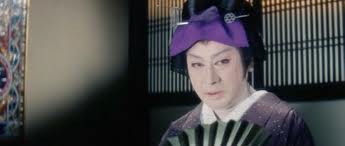
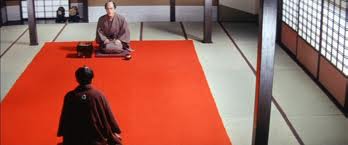
Ichikawa Kon’s masterpiece An Actor’s Revenge (雪之丞変化 1963) manages to add extra - and delightful - complications into any conversation about adaptation and fidelity. I won’t reveal too much of the story in case you haven’t seen it (yet!); suffice it here to make clear that there’s enough in the way of vengeance, fighting, corruption and betrayal for a good evening’s reconfirmation of our total depravity.

What Ichikawa adapted is a more complicated question than it might at first seem: created to celebrate actor Hasegawa Kazuo’s 300th screen appearance, An Actor’s Revenge adapts the earlier Yukinojo the Phantom (1935), with Hasegawa playing an onnagata (female impersonator) kabuki actor seeking revenge in both films. Further complications: Hasegawa had built a stage reputation for himself as an onnagata before he moved into cinema, and the earlier film being adapted was itself an adaptation of a newspaper serial. Further re-workings have followed, both in opera and, in 2008, in another film version.


So far, so much in the tradition of complexity and borrowing adaptation brings along with itself; my interests in An Actor’s Revenge were provoked not so much by details or gestures to ‘fidelity’ at the level of story, but, rather, by more flagrant signs of their absence at the level of narrative discourse. Ichikawa plays up the filmic and cinematic by intense, dazzling experiments in colour. These stand as evidence, along with so much else, of what we’ve lost with the end of technicolor’s hegemony, and remind us that, for all the importance of kabuki and theatre at the level of story, the fact we’re watching a film, and the demands film makes in the narrative discourse, aren’t going to be self-effacingly minimized or obscured. Donald Richie’s Hundred Years of Japanese Film claims the clash of these two levels may in fact have been liberating:

The Yukinojo project also offered possibilities within the vast, uncharted realm of kitsch. Wada [who wrote the screenplay] found the original scenario so bad it was good, and kept almost everything. The resulting film is a tour de force of great virtuosity in which the director scrambled stage and screen, tried every colour experiment he could think of, and created one of the most visually entertaining films of the decade.

Is scrambling an altogether appropriate verb for indicating the sort of aesthetic work Ichikawa engaged in, though? The kabuki details are, to be sure, handled particularly neatly. Performances by Yukinojo (Hasegawa) act as narrative frames and stand as quite complex mise en abyme, while a certain stillness or stylized, ‘phrased’ acting reminds you of mornings spent in Kabuki theatres.


Those details, intensely pleasurable and intellectually provocative as they are in themselves, seem to me less important, though, than the frame breaking or well-nigh Formalist and estranging techniques Ichikawa deploys in bringing theatre and film into collision. There is, for starters, the matter of casting: Hasegawa plays both the onnagata Yukinojo and the Robin Hoodish Yamitaro the Thief, a doubling of a kind perfectly normal on the stage but disorienting in its matter of factness on screen. John Berra sees this as Ichikawa utilizing “every theatrical device at his disposal to enliven [the] narrative”, but isn’t the opposite energy at work? Don't the very theatricality of these devices point away from the theatre, towards the particular promise and energy of the world of film? Most striking, as evidence or example in that quarrel, is Hasegawa’s own body; revisiting a role he’d played close to 30 years previously, he’s a surprisingly plump, double-chinned, middle-aged and hairy figure to inspire, as he does, virtually suicidal love from Dobe’s beautiful daughter. Then there’s the camp sensibility (queer Japan yet again!) flaunting the conventions and laying bare the devices of theatre in front of the steady gaze of film. Namiji and Yukinojo’s chastely sexy love scenes, to my mind the best minutes in the whole film, even allowing for the audacity and glamour of the fighting, seem to send up both themselves, and their theatrical set of references.

What purpose behind these alienation devices? MacCabe reads high modernism as “in part a reaction to the new medium of film,” after which we see that “this new medium of film produces a new kind of adaptation.” Adaptation as reaction: we’re dealing with another case, perhaps, in which the relations of discourse are of the nature of warfare. An Actor’s Revenge has theatrical elements, naturally; these, though, against what some commentators may detect in them, serve an anti-theatrical purpose.


Fredric Jameson remarks of adaptation that

Only allegory can, I think, to justice to this unparalled historical situation, and I want to propose that individual works, either as external adaptations or as internal echo chambers of the various media, be grasped as allegories of their never-ending and unresolvable struggles for primacy. The novel, even when written for adaptation by film, necessarily wishes the latter’s eclipse and death, and seeks to demonstrate the debility of a medium that has to rely on a liteary ‘original.’ But at one and the same time film believe that its triumphant incorporation of the literary and linguistic hypotext into itself, in a generic cannibalism or anthropophagy, sufficiently enacts its primacy in the visual age (itself blissfully unaware of its stealthily approaching digital rivals). Such is the deeper allegorical sense of the encounters recorded here. (232)

An Actor’s Revenge could, finally, then, be read as a form of vengeance and historical triumphalism over the very form of acting and theatricality it seems so lovingly to represent and chronicle. Kabuki functions here in the same way as African artifacts displayed in a Victorian-era London study: they’re signs of film’s colonizing project, evidence of the claims film makes for its capacity to represent, mannerisms marking out the limits of a particular historical period.


Theatre in this film - both at the level of narrative discourse and, within the story, as detail, something for us to ponder whilst watching others watching - makes an anti-theatrical claim, standing as a rebuke to all those irritating moments in theatre criticism when we’re told in pious tones that theatre can’t be recreated out of its moment or context. Look, Ichikawa announces with all those flourishes of colour, and here it is again!


Given the cultural and political values supporting them, there’s no wishing away the questions of adaptation, fidelity and ‘truth to the spirit’. This isn’t to suggest that they’re questions that can be answered, though, or, following Bazin’s insight, that they make all that much sense as questions in themselves. Ichikawa’s genius in An Actor’s Revenge lies in his realization that, with adaptation as with so much else, attack is often the best, if not the only defense: the film version can live, in this logic, only after consuming the life of its rival in theatre.


Sources

MacCabe, Jameson, and Andrews’ comments are all from their chapters in the splendid new collection Colin MacCabe, Kathleen Murray and Rick Warner (eds.), True to the Spirit: Film Adaptation and the Question of Fidelity (Oxford University Press, 2011). I’ve also been reading Linda Hutcheon’s Theory of Adaptation (Routledge, 2006); after many years of relative silence on the question in the Anglophone world at least, adaptation is becoming a live topic once more.

I took some details of An Actor’s Revenge from John Berra’s essay “Vengeance is Mine: Authorship and Identity in Kon Ichikawa’s An Actor’s Revenge”, included with the MadMan DVD release of the film.

Friday, 27 May 2011

The Jargon of Authenticity


David Burton is most likely New Zealand’s leading food critic; whatever that exact status, it’s certain that his books and wide-ranging writing on food – deeply informed, careful, grounded in decades of research and careful reflection – mark him as a major figure in contemporary food writing in English. His eminence and exemplary status, then, offer reasons to read his works following what the narratologists call a symptomatic interpretation, looking for the ideological and political codes they unwittingly blurt out.


Burton’s prose – with its arch mannerisms, its laboured wit, and the carefully feigned casualness with which it constructs our image of the curmudgeonly implied author – offers suggestive images and fragments, clues to the ideology which it serves. In the era of what Mark Davis calls “the decline of the literary paradigm” and the rise of the celebrity chef, careful attention to the writing of food writing may present political insights of the kinds we used to demand from critics reading literary novelists. If Jamie Oliver’s Mockney gushing over the dishes he prepared for Blair and Berlusconi stands now as a record of one strain of New Labour’s elitist vulgarity, Burton’s concerns follow longer-term shifts in consumption and class society.

Burton’s highest accolade is that he finds food “authentic.” I started, after returning to Wellington last year, keeping clippings from each time his columns used the word, but it soon became clear how pointless the task was; the weeks when ‘authentic’ or ‘inauthentic’ didn’t appear were rare enough to seem remarkable in themselves. “Authentic” food is sometimes followed by checks on the racial purity and authenticity or otherwise of restaurant owners or staff: a piece in Cuisine magazine last year on Japanese restaurants noted sniffily that most of the owners profiled weren’t Japanese but instead Korean. Would we make the same background checks on Ford car dealers to be sure they’re all from Detroit? The racism inherent in the gesture (and one very rarely applied to New Zealand chefs trying their hand at different European traditions) goes all but unnoticed.


It makes perfect sense, of course, for a food writer to care about the quality of food and the coherence and flavour of dishes, but isn’t authenticity a particularly ill-suited sign under which to travel? Doesn’t the history of food itself – a history Burton’s own books do a great deal to reveal – reveal the cross-cultural, migratory, productively contaminating and inventive energy which comes from human travel and social interaction? Most of the time ‘authenticity’ is used as a marker to keep others out, or to insist on traditions with dubious roots and stability: it’s no accident that many of the most of what one thinks of as ‘typical’ Japanese dishes – okonomiyaki, say, or teppanyaki – date, in the form we know them, from the post-war period. A survey in the Japan Times a few years back revealed kare raisu, the Japanese take on an Anglo-Indian interpretation, as most readers’ ‘typical’ comfort food.


This is to say nothing in defence of food fads or ‘fusion’, but merely to note that ideas and flavours respect few borders: my favourite food memories from my time in Tokyo are of those meals which were the least authentic, those wonderful Japanese takes on Italian food, mushrooms and fish eggs stirred through pasta and then dressed with nori. Who’s to police what, and where?


Most advocates of “authenticity”, however, would react indignantly to being classed as gate-keepers and racial purists. Aren’t our eating habits and all those ‘ethnic’ restaurants a sign, as the argument goes, of our enlightenment, of the multicultural sophistication of the contemporary liberalism? The racist term “ethnic restaurant” gives that particular game away, and matches the exclusions supporting contemporary liberal thought. Are Pakeha so at one with the Universal they’re able to dispense with talk of their own ethnicity? ‘Ethnicity’ is fine as additional glamour and as a consumable lifestyle component, but it will be kept in very particular places, and its excesses policed.

A seemingly apolitical obsession with culinary ‘authenticity’, then, works in parallel with the kinds of ‘authenticity’ political multiculturalism authorises: activities which promote separation, distance, and reified cultural practices – the Multicultural Festivals so beloved of city councils the developed world over – are promoted, while vehicles for cultural communication, contact, blurring and exchange – the trade union movement, centrally, joint political struggle, the kinds of interactions working-class social and industrial life imply –are denied or belittled.

Slavoj Zizek has described multiculturalism as “the cultural logic of multinational capitalism”, and his remarks illuminate Burton’s obsessions:

… the ideal form of ideology of this global capitalism is multiculturalism, the attitude which, from a kind of empty global position, treats each local culture the way the colonizer treats colonized people—as ‘natives’ whose mores are to be carefully studied and ‘respected’. That is to say, the relationship between traditional imperialist colonialism and global capitalist self-colonization is exactly the same as the relationship between Western cultural imperialism and multiculturalism: in the same way that global capitalism involves the paradox of colonization without the colonizing Nation-State metropole, multi-culturalism involves patronizing Eurocentrist distance and/or respect for local cultures without roots in one’s own particular culture. In other words, multiculturalism is a disavowed, inverted, self-referential form of racism, a ‘racism with a distance’—it ‘respects’ the Other’s identity, conceiving the Other as a self-enclosed ‘authentic’ community towards which he, the multiculturalist, maintains a distance rendered possible by his privileged universal position. Multiculturalism is a racism which empties its own position of all positive content (the multiculturalist is not a direct racist, he doesn’t oppose to the Other the particular values of his own culture), but nonetheless retains this position as the privileged empty point of universality from which one is able to appreciate (and depreciate) properly other particular cultures—the multiculturalist respect for the Other’s specificity is the very form of asserting one’s own superiority.

Authentic Class Relations


For all the talk of authenticity, certain constants from the cultural ‘centre’ remain, and woe betide the waitress with English as a second language or an ‘accent’ (a review from 2002 moaned about the ‘sah-poons’ Burton was offered at Sakura Restaurant) or a restaurant with parts of its menu untranslated (last week’s complaint). These gripes – alongside the usual reviewer’s complacent moaning about standards of service – serve a crucial class function, interpellating us as the subjects of middle-class consumption. Again, the assumed accent-less status of the writer goes unnoticed; if others have ‘accents’, what status then for our own speech? Concerns about “poor service” – a term here covering everything from signs of underpaid and overworked exhaustion through to insufficiently obsequious competence – act to insist on a distance between diner and waiter, a distance for fantasy class investments and egotism.

The historian Ralph Samuel, writing almost thirty years ago on the cultural transformations Thatcherism worked in Britain, observed that

The new middle class have a different emotional economy than that of their pre-war predecessors. They go in for instant rather than deferred gratification, making a positive virtue of their expenditure, and treating the self-indulgent as an ostentatious display of good taste. Sensual pleasures, so far from being outlawed, are the very field on which social claims are established and sexual identities confirmed. Food, in particular, a postwar bourgeois passion . . . has emerged as a crucial marker of class.

Little has changed these last decades, and Burton makes explicit the links between his own project and its social audience:

To explain all this [the culinary renaissance], we may cite the breaking down of trade barriers and the consequent freeing up of imports; the impact of global fashions; and the information age bringing television cooking shows, cookbooks and magazines to a greatly expanded middle class determined to acquire the trappings of culture


One of the by-products of neoliberalism’s success has been that its key ideological foundations have, for many years now, been able to pass themselves off as outside the realm of the political, as common-sense, as universal truths of economic and social life. The tag-team roles of the main parties in the 1980s and 1990s in introducing the neoliberal order helped this process. What I’ve tried here is to suggest some ways that, when the topic is seemingly non-political, symptoms of that ideological process speak themselves. Food reviewing, perhaps, offers itself as political commentary in a way other, more ‘relevant’ discourses, find themselves unable to do.

And what am I having for dinner? Something inauthentic, of course, prepared by a cultural interloper. Just like everybody else.

Sources

Burton’s quote I’ve taken from his Biography of a Local Palate (Wellington: Four Winds, 2003), pp. 53 – 54.

Samuels’ lines are quoted in Alex Callinicos, “The New Middle Class and Socialists”, International Socialism, 1983.

The illustrations for this post are from two food-themed manga: Oishinobo, the classic food-critic manga, and Yakitate!, an odd wee tale about the quest for "Ja-Pan", the truly Japanese bread.

Wednesday, 18 May 2011

Shinjuku Boys


Yesterday was the International Day Against Homophobia and Transphobia (IDAHO). Friends and comrades of mine in Australia marked the day by taking part in speak-outs and rallies building the campaign for same-sex marriage. The Anglican Church in Sydney is trying to stop an important rally for LGBTI rights taking place this weekend, so this lead-up week must have a particular political and emotional force and charge. There were events in New Zealand too, and around the world.


One of the nice things about living in New Zealand again is being within a social formation where the movement has won a certain, enduring, space for lesbian and gay lives, and being able to enjoy the great benefits that brings to all of us. Particularly around where I live in Newtown, for reasons which aren’t clear to me (I fit here the cliche of the straight man for whom obvious social signals are a mystery), there are plenty of gay and lesbian couples living visible lives: as I walk to work each morning I pass a man kissing his boyfriend goodbye for the day, a gesture touching in its (I think calculated) combination of workaday normality and understated but significant physical bravery. This isn’t a tale of lives divorced from the working class, either, as one currently popular narrative in Labour Party circles would have it; these guys look like they’re on a budget, and their shoes show all the signs of regular use. There’s more to win – full marriage rights, for one – and nothing is permanent. Still, seeing two men kissing each morning is a nice, and educational, start to the day: plenty of heterosexual men (myself included) would struggle with that kind of relaxed emotional expressiveness, whatever the wider questions of sexuality. It hasn’t always been this way, of course, and it took a mass movement to win what freedoms there are. The activists in that movement took risks: as Bill Logan has written, “it was no rose garden, but it wasn’t a mistake.”

It’s the transphobia part of the international day I’ve been thinking about recently, though. I’ve learnt a lot, as I suspect plenty of others have too, from the issues that have been raised by the same-sex marriage rights campaigns in Australia and the United States, in particular around the struggles within these movements for the voices of trans people to be heard, and how their contribution to the struggle has strengthened its reach and energy. Sherry Wolf’s essay “To Riki, with respect” moved me, and set other thoughts in motion.

この道


I’ve written before about “this path”, the life of “this world” that is Queer Japan. Reading contributions around IDAHO yesterday, I remembered Kim Longinotto and Jano Williams’ excellent documentary Shinjuku Boys (1996).

Shinjuku Boys follows the lives of a group of onnabe working in The New Marilyn nightclub in Tokyo. The term Onnabe – the pun here plays on 女 – woman – and 鍋 – nabe, those lovely hot pots that make Japanese winters such fun and which demand a good deal of stirring and mixing – refers to women dressing and/or living as men and working in a “host” bar catering to women clients. Some are transitioning to new physical identities. The clientele are, in the main, heterosexual women, although many form ongoing emotionally and sexually intimate relationships with hosts they meet at the bar. The documentary, in allowing these people to speak openly and freely about their lives, is an intensely moving, educational, and inspirational work.


That last paragraph was difficult to write, and doesn’t communicate particularly well, because each of the terms I’ve looked to ends up proving as inadequate as the one it replaced. This difficulty mirrors the limitations in my political vision the film helped expose. First time around, with well-meaning bafflement, I spent most of my time trying to fix in place precisely what couldn’t, and shouldn’t, be fixed: who were the men? Who were the women? Were any – or all – of the people interviewed lesbians? Which people lived as women? Which wanted to be men?

This line of questioning, apart from being a particularly rude and unpleasant way of talking about other people, is politically unhelpful, and Shinjuku Boys helped me see why. That the labels of sexuality, gender, and, oftentimes, sex itself didn’t fit for many lives was, for the interviewees, a given: things became difficult when other people (and, through them, social forces) tried to make them fit, with sometimes tragic results. Some onnabe were happy, others unhappy, much like the rest of the world: what they shared in common, though, was a determination to live the kind of life they wanted to live. A good aim and, if the social fixations, expectations and clothing- and genital-attractions of each of the sexes didn’t fit so well, bad news for those expectations.


Shinjuku Boys, in giving its commentary over to the subjects of the documentary themselves, forced me to confront complexity. These people’s frankness about identity, sex and sexuality was also a reminder of the importance of respect and privacy, of the sorts of conditions necessary to make political conversation possible: you can’t learn about other people’s lives or needs by demanding easy affiliations from them. The power of unity in struggle is, among many other things, the power of being different. That’s difficult, and needs working at, but I’m sure it’s essential too.

O wad some Pow'r the giftie gie us
To see oursels as others see us!
It wad frae mony a blunder free us,
And foolish notion:
What airs in dress an' gait wad lea'e us,
And ev'n devotion!


The struggle continues: I was very pleased to see the first openly gay candidate win public office in Japan earlier this year. Socialist Ishikawa Taiga marches on May Day, campaigns for AIDS awareness, writes thoughtfully on gay life and has opinions on US bases. (The hint here, again following right-wing commentary on the state of the NZ labour movement: it’s possible to multi-task).


Here in Wellington next month we’re going to march to “Queer the Night”, a sign of LGBTI pride, and against homophobic violence and threats.

So, let's rock society!


Sources

Most of the best political and social websites coming out of the Japanese lesbian community start with pages asking men not to view or enter them. Fair enough. I’ve respected those requests and won’t read or link to them, but want to record their absence here. If you’re a woman reading this you might like to explore further.

In keeping with the international day being about action and education, I'd like to acknowledge the extraordinary education in sexual politics and LGBTI history and struggle through my time in Socialist Alternative when I lived in Melbourne.

Friday, 6 May 2011

Australia's Pacific War


Part of the great ideological power of ANZAC Day now is the way it mobilises imagery stressing the pity and sorrow of war in order to strengthen militarism and Australia and New Zealand’s military role in the world. Few events grant the armed forces such opportunities for public display and social legitimacy; fewer still so successfully de-politicise the discussion of political questions. When Marilyn Lake and Henry Reynolds brought out their collection What’s Wrong With ANZAC : The Militarism of Australian History last year, they faced sustained hostile commentary from both the liberal and right-wing press. In New Zealand it’s taken a legal battle right through to the Supreme Court to establish that free-speech principles stand on April 25th.

The event’s power is recent, and remarkable: baby boomers I’ve spoken to marvel at the transformation of the unpopular, poorly attended and jingoistic events of their youth into the well-nigh universally marked dawn services of today. Part of this appeal is no doubt to do with the passing of the generation who fought in World War Two – I remember that as my own half-formed justification when, as a teenager, I turned out in Queen’s Gardens – but, whatever our individual and complex emotional feelings about loved ones and relatives, the political and social consequences of ANZAC Day’s revival are everywhere evident, and damaging.

This ANZAC Day I was flying home from the Marxism conference in Melbourne, an event where I’d been lucky enough to be able to attend the launch of Tom O’Lincoln’s new book Australia’s Pacific War: Challenging a National Myth. This book is an excellent, and sorely needed, corrective to the nationalist and pro-war mythology bolstering Australian military and imperial ambitions, and informing the cultural work on ANZAC Day – Australia’s Pacific War is an anti-war counterblast, a critical account of how Australia and its allies fought in the Pacific theatre of World War Two.


The Pacific War has a particular significance in the mythology of contemporary Australian imperialism: for all the drunken revelry of backpapers taking time out from their OEs to worship at Gallipoli each year, World War One offers slim pickings for today’s apologists for war. Widely accepted as an exercise in bloody futility, distant, confused; the First World War serves too easily in the anti-war narrative for the right ever to have bothered much with its reclamation. (The grubby role of Australian and New Zealand troops propping up British colonialism doesn’t help here either: characters in Naguib Mahfouz’s Cairo Trilogy use the term “Australian” as a catch-phrase for abusers, pillagers and thugs). Against this, Australia’s actions in the Pacific can be connected to myths of the Second World War as the “good war”, for Australian independence against Japanese aggression, for freedom and democracy, for liberty against empire. It’s a myth which has suited many an imperial venture since.

“What I mean by the Pacific War myth,” O’Lincoln explains, “is a mass phenomenon, in which an elaborate belief system sustains social mobilisation…Instead of a fantasy of inevitable victory, we find a fantasy affirming the inherent validity of national war mobilisation – a national myth that underpins war-making today.” (viii). Replacing older, cruder myths of “inevitable victory” is in part what gives ANZAC Day its ideological force: mourning and recognising the dead, now, provides unwitting support for the set-up that ensured their death.

Australia’s Pacific War sets out an historical record very different to that the myth of the “good war” encourages us to imagine. Australia was never under threat from a Japanese invasion, and its rulers knew this. The fear of that invasion, though, was cleverly developed and exploited by the Labor government of the time to justify and extend war policies abroad and industrial exploitation at home. (Labour’s vile role suppressing civil liberties in both Australia and New Zealand deserves more attention: see, for NZ, Russell Campbell’s documentary Sedition).


Drawing on racist campaigns against the Japanese of long standing, Australia’s media and political forces used the war to whip up popular loathing and a de-humanising of the enemy. Where anti-Nazi propaganda focused on Germany’s leaders, anti-Japanese material was generalising, and deeply racist. O’Lincoln quotes from an article on “The Japanese as a Fighter” in the Melbourne Argus :

He was a mass of contradictions – he fought grimly, enduring terrible wounds, until he was destroyed; or he ran in screaming fear; or he blew himself to pieces with a grenade clutched to his chest or stomach. He was cruel and dirty and bestial. He killed his wounded rather than have them fall into our hands. He plundered and raped the natives. The Australians and Americans came to loathe him as one loathes something that is dirty and ratlike.

And this appeared after the bombing of Hiroshima and Nagasaki! Politicians exploit this set of associations still; O’Lincoln quotes Alexander Downer in the early days of the “war on terror” referring to “monsters such as Hitler, Mussolini and Tojo.” Even George Bush himself wasn’t as capacious in his genealogies of the Axis of Evil.


Australia’s Pacific War details the Australian army’s role in sustaining British – and Australian – colonial domination in the Asia-Pacific region; Australia’s invasion of East Timor; racism in the occupation of the Japan and repression of the Japanese labour movement; and the impact of the war on democratic liberties and class struggle at home. Life for people in colonised countries under Japanese rule could be very unpleasant: in this, it differed little from life under any of the other competing colonial forces in the region. O’Lincoln quotes from a diary of an Australian soldier:

The private local war [in East Timor], Portuguese versus native, still goes on in its bloodthirsty way, and provides some humour for sub units. One of our patrols near Mape, out hunting the Jap, encountered a Portuguese patrol out hunting some natives, they exchanged compliments and went their various ways.

This all makes for grim, but important, reading, but Australia’s Pacific War isn’t just a chronicle of war’s horrors. O’Lincoln includes chapters on unrest on the homefront – industrial unrest, certainly, but also changing attitudes to gender and sexuality – and considers some of the experience of ordinary soldiers in Japan, and how these human encounters changed their attitudes and actions. There’s plenty on the ongoing resistance of indigenous people – in Australia and in colonies abroad – to the treatment they received from occupying forces.

Australia’s Pacific War is written to “challenge conventional views of the war.” I hope it does.

Sources

Tom O’Lincoln’s website has some excerpts from the book, as well as supplementary material on questions it raises – on the (compromised and occasionally horrifying) position of Communists in Australia towards the war, on labour in the war, and more.

ANZAC Day has been a site of social conflict and contestation as well as forced unity: read Kyla Cassell’s very good article here (PDF) on class conflict at ANZCAC Day celebrations between the wars.

Monday, 18 April 2011

In the Gap


I’m able to place, with quite some precision, where my first voyage around Kendrick Smithyman collapsed. Somewhere between “Flying to Palmerston” and “Research Project”, I gave up: my copy of Peter Simpson’s Selected Poems has a spine all broken and detached up to this point and then, beyond, is untouched and elegantly new. Smithyman, in my first encounter, was too difficult, too obscure, too demanding to count as what I considered real poetry. (In those stupid judgements I wasn’t alone; my copy is marked, as almost all my teenage purchases are, with the tell-tale vivid of the remainders sale upstairs at Dunedin’s UBS). The further Smithyman travelled from his early ‘contaminations’ – Auden, of course, Dylan Thomas, alas – the less his work fitted into my own sense of what poetry should be and what it should do. These weren’t, in other words, poems which shouted at me things I already believed, the demand, it seems to me now, of most latter-day Romanticism.

Re-discovering Smithyman some years later as a gauche and homesick student at the Baillieu Library in Melbourne, all those supposed vices had transformed themselves into virtues. Smithyman was worth the wait. Here was a poet at once intellectually absorbing and emotionally engaging, lyrically deft and formally inventive, and, above all, demanding, and with a fine ear and sense for what demands were needed.

We were/are all of us
Alienated. That’s how we belong.
He was deaf, deafened by such a distance –

out there, if you took a firm line
You’d fetch no landfall until
Chile. Think of that now! after
An afternoon at an old German pub downriver,
Pub and museum of a folk.

This was their cargo’s way,
crooked as a founder’s motives.
The distance which you swallow at a gulp –
it was their distance.

(“Movements for Coastal Voices”)


The detailed carefulness of “[t]hat’s how we belong” sticks with me, as does Smithyman’s commitment to a poetics capable of wit and mischievous humour while all the while recognising the complexity and difficulty of material produced in the New Zealand social formation. As he argued in Poetry Yearbook (1954):

Society is complex in its activities and its relationships, and the members of a community are complex. A section of the poetry of and advanced and intricated community must inevitably be complex, and because complex, obscure – which is not to say that most of the obscurity cannot eventually be understood in the major part. …

We have to reckon in short that the mirror which art holds to nature may be a dark glass reflecting a paddock where undoubtedly dark horses are capering.


It’s fitting, given the first gaps in my Smithyman experiences, that I’ve had to live through another, shorter, one on my way to encountering Scott Hamilton’s exciting selection of unpublished Smithyman poems, Private Bestiary. The first print run of this selection sold out very quickly – unusual, surely, for a poetry collection – and it was some months between my order and the book actually arriving here in Wellington. It’s worth the wait again.

Surely there is
a moral in those sandhills
if I had wit enough to tell it.


These “first steps into a private bestiary” (there are supposedly hundreds of uncollected Smithyman poems and drafts in his archives) is enormous fun: the poems themselves are beautiful – and often strikingly surprising – and the introduction and notes helpful and provocative. (Those who know the Reading the Maps blog will recognise the house style: erudite, engaging and engaged, witty, occasionally rambling).


Private Bestiary builds the case, already present in Peter Simpson’s selection, for reading Smithyman not as a self-consciously ‘difficult’ poet aiming for obscurity, but instead as another example of the Wordsworthian model of “a man speaking to men”, communicating about issues and themes of great difficulty, to be sure, but never in a needlessly off-putting or sterile manner. The great theme Private Bestiary selects and presents is the recognition that “there is / a rabid violence / in the earliest stories,” the violence of colonial settlement and expropriation.

This recognition is accompanied by an essential counter-tradition, the only way it can be given useful life: Smithyman’s poems – and it took the introduction and notes to bring this fully alive for me – are packed with the details of working-class Pakeha and Maori rebellion, the Red Feds, rebel unionism, unofficial history. There’s little pleasure here for liberal guilt or piousness; plenty of material to provoke the ‘rumour of another history.’

***

“Form fascinates when one no longer has the force to understand force from within itself. That is to create.”


There is difficulty in these poems, though, but it’s worth learning to seek in that difficulty the source of their pleasure. Smithyman’s formal experiments; his densely allusive world of private reference and location; his word-plays and asides building to a sense of menacing over-reading and excessive signification: all of these, I recognise now, are part of a pattern and artful design in the work – the source of the stimulation – instead of a flaws in pieces which could be perfected by a little lyrical smoothing out and simplifying. The broken, improvisational associations and asides of the poems in Private Bestiary point somewhere.

The strain here, and its symptom, an occasional obscurity, is History itself:

But whatever portion of this faculty we may suppose even the greatest Poet to possess, there cannot be a doubt that the language which it will suggest to him, must often, in liveliness and truth, fall short of that which is uttered by men in real life, under the actual pressure of those passions, certain shadows of which the Poet thus produces, or feels to be produced, in himself.


That language of real life, in the poems selected here, stresses both the dishonesty of Pakeha myths of origin, the anxious elimination of colonial history from our minds (“We are a myth of our making”) and its insistent presence, coupled sometimes with other social orders about, in this piece from 1965, to erupt:

A view of our circumstance is
narrowed: this side, unreal safety.
Down in the valley men console
in a thoroughly public bar.


*****

The other, compelling, case made in Private Bestiary is for Smithyman as regionalist. The Northland Smithyman loved so much may as well be a foreign country to me, so different are its signals in botanical detail, historical reference and climate from my own stock of South Island memories and affiliations.

That sense of regional detail and particularity is useful, though: there’s nothing like an alienation effect or two to force the re-thinking of important issues.

There’s a politics to this aesthetics, too:

This is a political parable,
a harbour at low tide. Almost dark,
we’re only visitors, we don’t know twists and turns,
ins and outs of waterways or limits.
Like everyone else who doesn’t belong, we’ve heard
about disputed grounds, land claimed (and handed) back,
bad feelings, tensions, even death threats.


Yesterday afternoon, having made some of these notes earlier in the morning, I went to the premiere of Operation 8, a very important documentary about the “anti-terror raids” from 2007. I won’t write here about the politics of that particular – and ongoing – event, except to make the minimal observation that it represents a particularly shocking and disturbing injustice and assault on civil and political rights.


What struck me, amidst all the horrifying details of police maliciousness and media and Labour government connivance and complicity, was the ignorance so essential to the whole story’s success. There are the telling details of throw-away ignorance, to be sure – notably here the inability of most journalists covering the case to learn Tame Iti’s name – but a deeper, structural racism and ignorance (what might be glossed, following Smithyman, as provincialism against regionalism) sustained the entire media and police fantasy of a terrorist plot in New Zealand.

Time and again in the documentary people from Ngai Tuhoe being interviewed made reference to earlier land seizures, to sovereignty never ceded, to confiscation, struggle and resistance. They had a coherent, and detailed, narrative, reaching back to Rua Kenana, the 1860s East Cape wars, and further still. Each of them articulated demands for self-determination, and placed their own (extremely trying) current situation in an historical context of racism and oppression. Against this, the wildness and extremity of the Dominion Post’s coverage – and of the vocabulary from Bush’s “war on terror” translated into the New Zealand context – sounded maliciously fanciful and bizarre. The narrative those Tuhoe campaigners took for granted, though, was one which, I imagine, many viewers would have struggled to recognise, still less comprehend. National stories submerge the recalcitrant details of resistance.


The Ureweras are the site of plenty of Pakeha projection and fear, and those caught up in the October raids are the latest victims of that paranoia and its historical background. There’s important and detailed historical work – Judith Binney’s massive history, most obviously – which counters this, but something of the distortions of a nationally-minded pose remain.

Smithyman’s work reminds us of the ideological fictions which make up the imagined community “New Zealand”, of the regional specificity of so many of our struggles and campaigns, of the patchy – and often inconclusive – process of colonisation, of the presence of historical injustice pressing upon the present:

One thing for sure, Turuki isn’t going
to ride through here again; he’s been dead
a while since, somewhere over behind Ohiwa.
Things aren’t better than they were?
No way. No way at all.

("Moutain Stop")

I don’t find the familiar in this collection, then. No way. No way at all. And, for that very reason, it’s a New Zealand voice of a kind I’m finding more useful than ever.


Sources

You can – and should – buy a copy of Private Bestiary from Titus Books here.

Rebel Press have put out an oral history of the so-called “terror” raids, The Day the Raids Came. You can buy that here.

The line on form’s fascinations I’ve taken from p. 3 of Jacques Derrida, Writing and Difference (1981).

Friday, 1 April 2011

Zainichi as Bare Life

Everyone knows it yet
It’s not on the map
It’s not on the map so
It’s not Japan
It’s not Japan so
It might as well vanish
It doesn’t matter so
We do as we please

(Kim Si-Jong, “Ikaino Poems”, 1975)

Translation opens us to other worlds, certainly, but it can also perpetuate exclusions. The first time I read Yu Miri’s Goldrush its Zainichi context was lost on me, neither surname nor Pachinko-parlour setting, at that time, setting off any of the appropriate cultural cues amidst my own ignorance and confusion. It’s hard to image what Stephen Synder in his (excellent) translation could have done to make this context more apparent, without resorting to those cumbersome notes and appendages which signpost what’s supposed to work unsigned, and, besides, the blithely arrogant under-reading of that initial experience (“aren’t I multicultural, one of those rare folk who consume literary fiction in translation!”) may well mirror broader patterns of Zainichi invisibility and exclusion.


Yu herself, anyway, refuses the label of “Zainichi writer” just as assertively as her Korean surname reminds Japanese-language readers of her own inescapable insertion into social ways of inscribing ethnicity and attendant racial oppression, and her darkly humorous, exacting stories can be read for their unsettling and probing observations on heterosexuality and sexual oppression or the nuclear family and violence as much as for any insight into Korean experience. Yu’s achievement, Lisa Yoneyama argues of Fullhouse, is to “probe for clues with which to disturb” the “problematic arrangements” of the modern family. Far from denying the importance of the Korean struggle, though, for Yoneyama – and I think she’s right – writing of this kind “can be disconcerting and threatening to those who desire to maintain the stabilized boundaries of family, ethnic community, and national polity and history, for they reveal and criticize the mutual imbrications of racism and bourgeois family values.”


It’s been quite a few years since I spent time being productively disconcerted by Yu’s writing, but I’ve gone back to her these last weeks after engaging with the scholarship of Sonia Ryang. A displaced intellectual and powerful writer, Ryang is an engagingly precise and provocative guide to the complexities of the situation for Koreans in Japan, and her scholarship – a model of lucidity, engagement and sheer intellectual excitement – stirs up all manner of questions official politics would prefer left unanswered.

Zainichi, in the usual liberal phrase, are described as “second class citizens” in the Japanese system: Ryang polemicises against the complacency behind this common-place. Zainichi are, of course, not citizens of any kind, second-class or otherwise, and part of their oppression stems from their systematic exclusion from all parts of Japanese political and social life. To be Zainichi is, Ryang suggests, to be reduced the quality Giorgio Agamben calls “bare life”, invisible, outside the rules and governing possibilities of the political world.

Besides, what is it to be Zainichi? We’re so used to talking about Chongryon-affiliated people as “North Koreans in Japan” that it takes the shock of Ryang stating the obvious to re-focus discussion: there are no North Koreans in Japan; Japan does not recognise the DPRK, and there are no official channels for DPRK citizenship, outside of diplomatic circles, to be maintained abroad.


DPRK-affiliated Zainichi are, then, doubly invisible. Mainstream anthropology, as Ryang points out, in framing most of its studies of Zainichi as studies of ‘outsiders’ in Japan, perpetuates this disenfranchisement. When considered from within, as a diaspora without homeland, the political priority and possibilities for Zainichi seem rather different.

There’s very little attention given, in media reports and elsewhere, to the historical complexity of the situation which led to their being ‘North Koreans’ in Japan: in insisting on this complexity, Ryang turns it to usefully activist and anti-racist ends. If most studies of diaspora look at the outsiders, what about turning attention to the host societies?

A society such as Japan that firmly stands on the belief in its monoethnicity might be unfit to be a host society for modern diasporas. I state this with a certain urgency: it is public knowledge that since 9/17, North Korea has been roundly demonised and Chongryun-affiliated Koreans marginalised and isolated. The current situation creates constraints not just on the diasporic community but on Japanese society as well (Ryang, “Visible and Vulnerable: the Predicament of Koreans in Japan”, 79)

***


The Zainichi struggle is, though, as anyone who knows the grubby history of Chongryon will be aware, not just a matter of exposing the lies and racism of the ruling order: it’s also a question of questioning, and opposing, stifling nationalisms and orthodoxies within the community itself.


Ryang takes the question of naming – the honmyo (true, Korean, name) and tsumei (‘passing’, Japanese, name) – and subjects this site of so much well-meaning, or not so well-meaning, dogmatism to useful interrogation:

It is all very well to condemn passing names as the legacy of colonialism. But as long as there exists strong discrimination against Koreans in Japan – whose mark is most clearly discerned by name rather than skin colour or accent, for example – the use of a name is no simple matter. When a subject prefers a particular name – no matter how compromising such a deployment may be in the eyes of the nationalist orthodoxy – how can others (ethnic community leaders, teachers, parents, or even the nation-state or history) force them to use another name? Whether a Korean name is honmyo for an individual is not a given, since otherwise it would be tantamount to assuming that one’s alien registration name has to be one’s real name. After all, who decides which name is true to the person? The law? The community? Parents? Teachers? Or the person herself? Rather than assuming that the “true self” exists in “true Korean names”, we should withhold conclusions about the authenticity of names. (Ryang, “Introduction, 14).

It’s not just the insistence on complexity which is inspiring; Ryang insists on individual agency and the capacity to struggle.

The very ambiguity of the question of names for Zainichi points to some of the political possibilities of the position they inhabit. Issuing ‘anthems from nowhere’, residents of the imaginary country which, in the words of footballer Jong Tae Sae, is “another country in Japan”, Zainichi, in their very in-between status, defy the nationalisms which disfigure the region:

More recently, as the association with either North or South has waned, the term zainichi, meaning “existing in Japan”, has become common currency for representing Koreans in Japan. This name does not come without problems, in my view. To begin with, the term is parodic; it inverts the reality of the treatment of Koreans by the Japanese state. In this system, Koreans are treated as outsiders and their exclusion is justified on the basis of that they do not have Japanese nationality. By calling them zainichi, as if they merely “exist” in Japan, the name obscures their clear disenfranchisement. Although calling oneself zainichi chosenjin or zainichi kankokujin no longer denotes exclusive association with either the northern or the southern regime, the contours of zainichi life are becoming more complex and volatile. The parody name zainichi condenses this complexity: in spite of the diversity of names for Koreans in Japan, not one captures them properly. (Ryang, “Introduction”, 11).


This condensed complexity inspires anti-racist organising and activism, from Zainichi groups in the United States to Tokyo.

There’s plenty in Ryang’s thought I disagree with: her writing consistently down-plays the importance of the struggle aspect of class struggle, and accedes too easily, perhaps, at times, to claims of Zainichi invisibility which in turn erase their obvious contribution, and importance, in Japanese working-class politics. (For an example of this, see her brilliantly argued but, to my mind, one-sided piece “The De-Nationalised Have No Class” in Japan Focus.)

It’s unusual, though, to encounter academic writing which combines accessibility and political urgency and intensity with carefulness and rigour. Now, while the humanities are under such sustained attack, her work stands out as an example of the sort of practice I want to take up and defend.

Sources

I’ve quoted from two collections here:

Sonia Ryang and John Lie (eds.), Diaspora Without Homeland: Being Korean in Japan (Berkley: University of California Press, 2009).

Sonia Ryang (ed.) Koreans in Japan: Critical Voices from the Margin (London: Routledge, 2000).

Lisa Yoneyama’s essay is in Koreans in Japan. The Kim Si-jong quote is taken from Melissa Wender’s article in the same volume. Ryang has also published a number of other very useful books; one I’ve found particularly helpful is North Koreans in Japan : language, ideology, and identity (Boulder, Colo. : Westview Press, 1997).

With thanks to Shomi, who introduced me to Yu Miri's writing, and whose 2005 conference presentation started me thinking about translation in the Zainichi context.

ShareThis