Tuesday, 2 August 2011

Manual of Fear


Coverage of Norway’s terrorist atrocity has been an instructive reminder in how ideology circulates, and works. First the blether of uninformed experts analysing how the attacks fit the patterns of Al Qaeda and serve as a reminder of the need for and justification of the War on Terror. Then, once that particular line becomes unsustainable, a concerted depoliticising of the tragedy, figures of the “lone gunman” and “madman” replacing talk of terrorism, fascism and far-right fantasies. Worse again than this de-politicising has been the covert and not so covert victim-blaming and dog-whistling indulged in by media forces who, having spent much of the last few decades obscuring the fact that, in Gary Younge’s words, “The biggest threat to European democracy is not Islamic terrorism or multiculturalism” but fascism, work accounts of the bombing and shooting into a sickly familiar narrative. The BBC was particularly despicable, interviewing an English Defence League leader for his “insights”; the Jerusalem Post took the opportunity to editorialise about the “failures” of multiculturalism. John Key, meanwhile, always mindful of chances to parade his particular, well-nigh Bakhtinian parodic deconstruction of Prime Ministerial discourse, solved the problem by crushing both lines together, taking the opportunity to remind us that this was why New Zealand troops are in Afghanistan.

Taking the mass murder of political activists by a fascist as an opportunity to attack multiculturalism is grotesque and yet unsurprising. The history of anti-semitism is full of examples of accounts that, claiming to respond to bigotry, project it onto characters in the Jews instead of their persecutors, a pattern repeated in each new racism and prejudice.


A Coward Who Does Not Want to Admit His Cowardice To Himself

In the Tokyo summer of 2008 I had a brief, and hateful, job teaching business English to public servants out of a language school in Ginza. One evening, in the middle of an example from an article on the then-unfolding Great Financial Crisis, a student remarked casually that the problem was bound to favour the US over China in the end because, of course, with the Jews running everything they’d make sure it turned out that way. Unsure I’d understood him correctly, and in how far I could push the situation, I challenged him, but the conversation didn’t get far. It wasn’t racism, my student insisted, because he admired the Jews for what they’d achieved: as any patriotic Japanese could tell you, world domination wasn’t easy. The best thing you could say about Taro Aso, my student went on, was that he was what you’d call a real Jew. (Shades of Grammy Hall!)

I should have pushed harder, and been more assertive, and I still feel slightly grubby remembering that evening and the ease with which I backed away from a necessary confrontation with open, and zealous, bigotry. My excuses – the job, my situation, our mutual language barriers – sustained me for a while, if in an unsatisfying way, and, behind them, there was a more basic shock: how could the language of anti-semitism, the most European of prejudices, express itself in Japan?

Manual of Fear

In the autumn of the next year I took my mother and sister on holiday to Nikko, a serene, quiet, unusual part of Japan. We stayed in a village a few stops down the line from Nikko itself and, before tea, I went out to buy some beer. On the way back, unexpected in the darkness, I walked past one of those yellow, painted community service signs that are scattered all over the Japanese countryside. This one read:

Be vigiliant and demand the expulsion of Aum from the community.

Somewhere in the area followers of Aleph, the remnants of a broken and demoralised Aum, lived in one of their communities, perhaps with a bakery or other business attached. Murakami Haruki’s The Place That Was Promised profiles the after-lives of cult members post-1995, moving in groups from town to town, setting up lives and then finding the police and local politicians forcing them out.


It was a disconcerting, and, for me at any rate, disorienting and decontextualised sight. The horror of 1995 - thousands injured, many dead, terrifying disruption to a city at its most vulnerable - is remembered everywhere, if obliquely, in Japan, in generalised fears and anxities.


Protocols of the Elders of Zion

The late David G. Goodman wrote an important book on Jews in the Japanese mind, and an article of his tells the story of the Protocols and their history in Japan. Through the 1980s and 1990s – from the Bubble’s peak to its burst, in other words – dozens of books and articles appeared based on the Protocols of the Elders of Zion, selling millions of copies. Goodman writes:

Jews were described in these books and in the large, gaudy advertisements that appeared for them in mass circulation daily newspapers as a clandestine cabal plotting to destroy Japan and rule the world. The Jewish plot, the books charged, had already succeeded. The United States, Japan’s chief ally and most important trading partner, was controlled by Jews, who formed a “shadow government” and manipulated U.S. policies for their own perfidious ends. Certain ministries within the Japanese government had already been taken over by Jews, it was said, and Japan was doomed unless something could be done. The enemy was ruthless, and the response, it was implied, had to be equally so.

The history Goodman traces has particularly important implications for our thinking about racism more generally: there have never been large Jewish communities in Japan, and, indeed, the role of Japan in sheltering Jews in wartime Shanghai stands out. Japanese anti-semitism cannot, then, be apologised away as a response to contact; it is, rather, Goodman suggests, that that “antisemitic ideas and the Protocols of the Elders of Zion have played an identifiable and deleterious role in the history of modern Japan”, and that these ideas are linked to ideologies and social forces within the social formation. We can, following Sartre or Abram Leon, link this ideology in the Bubble era to particular anxieties in Japan’s middle class, and to projections of evil to outside forces that allow internal divisions to remain unexamined.

Aum, in January 1995, a few months before the sarin gas attacks, published a “manifesto of fear”, declaring war on the Jewish “world government” and its plans to “murder untold numbers of people and...brainwash and control the rest.” The gas attacks, Goodman contends, can be seen as a opening salvo in that war.


As with the attacks in Norway and Brevick’s “manifesto”, there was plenty of the wild and outlandish about Aum with which to depoliticise their portrayal. The Elephant masks; the heady mix of Nostradamus, the Book of Revelation and Buddhism; the dancing election campaigners: a narrative of “craziness” isn’t short on illustrative material. The story of the Cult doesn’t, though, capture the full power of the fear and terror their attack achieved, nor does it account for the unsettling parallels of banality and paranoia between Aum’s imaginative world and that of Japanese society more widely. For total fear, it’s hard to imagine a better target than the underground, functioning as they do for Tokyo as the unseen centre: passing through Kasumigaseki on my way to work in Ginza I’d often think of how terrifying the morning of the attack must have been, and how difficult, in the crush and unpleasantness of rush hour, it must have been to realise that this was a distinct, and dangerous, terror.


For banality, though, Aum, a religion where, one of Murakami’s interviewees reports, it helped to have been to Tokyo University, managed to match its host society. It’s striking, reading Murakami’s interviews, how many of the former members have abandoned particular details of the faith but kept the method of conspiracy: one former member reports her doubts about Asahara’s approach unless, she adds, the Freemasons were involved in invading Japan.


The logic of Aum’s apocalyptic vision – and it is important that we insist that there is a logic here, that these aren’t “ravings” and thus able to be expelled from the realm of analysis and discussion – fits a familiar pattern of Japanese right-wing storytelling, from the self-pitying accounts of betrayal, from within by the Left or without by Jews, “third country” figures and foreigners, to the promises of war and redemption through national salvation. How different is this from Happy Science, from Ishihara’s comments over several decades, from the frenzied revisionism surrounding Yasukuni Shrine?


My suggestion is not, if this needs stressing, that these other forces are identical to Aum or that they plan mass murder in the near future. It is, rather, that political violence of the kind Tokyo suffered in 1995 cannot be removed from the wider discursive context in which its justifications and strategies were produced. Isolating Aum from the realms of what counts as the political is itself a political act, and one aimed at preventing examination of the kinds of ideological cross-contamination at work within far-right thinking and imagining. The same process is at work today.

Mori Atsuya feels that society lacks the vocabulary to account for the damage of Aum’s actions:

Ten years later, do we know any more than we did back then?

Unfortunately, the answer is "no." The series of Aum Shinrikyo-related trials unveiled very few new facts. I don't think this is because former Aum executives are hiding what they know or feigning innocence.

Rather, they, too, seem to lack the vocabulary to explain what made them carry out the heinous crime.


Meanwhile, society has stopped asking "why religions whose mission is to deliver salvation kill people," a fundamental question that kept nagging us immediately after the incident. Together with many other "whys," we put it behind us.


Perhaps what we flinch from is the fact that Asahara’s visions fit a pattern and share themes with much more mainstream and respectable ultra-rightist lines. Take away the laser beams, world conspiracies and global conflicts, and the central message, delivered via the various Tokyo University graduate “Ministers” is eerily recognisable: most will be wiped out, the elite will survive. The social formation is basically sound.

Sartre, in Anti-Semite and Jew, called the anti-semite "a coward who does not want to admit his cowardice to himself." The cowardice and self-pity of the conspiracy theorist and terrorist can be read symptomatically, then, for what they reveal about other versions of their narratives, more common, politically acceptable iterations of their main points. If these deranged rantings – on the global cultural war, on the race bent on world domination, on the sinister links between outside figures and cultural defeatists – sound familiar then we’ve good reason to be worried, and good reason to consider political responses.


Goodman’s final point is important. When so many accounts of European fascism reveal themselves to be covert translations of the fascists’ creed (multiculturalism has failed, this is the response of the white working class to their disempowerment, people have “real” and “genuine” concerns and so on), it’s worth remembering the place of the Protocols of the Elders of Zion in Japanese political discourse, and of the ways Aum managed to mobilise its rhetoric.


This mobilisation tells us something important about the targets of racism, and thus for anti-racist activism:

“Jew” for the antisemite is a free-floating signifier to designate the object of his animosity. Even the emperor of Japan, as Aum showed, can be a “Jew.” Aum’s gassing of the Tokyo subway was, in this sense, not only the first large-scale act of urban terrorism, it was also the first act of 21st-century antisemitism. Today, anyone can be a “Jew,” and everyone, even the Japanese, are at risk.


Sources

I learnt from the H-Japan list last month that Goodman died. He was a very important scholar, and I learnt a great deal from his work on avant-garde Japanese theatre. You can read his survey of the place of the Protocols in Japanese political life here (PDF).

Murakami’s Underground has been translated into English. David Mitchell’s first novel, Ghostwritten, responds to the sarin attacks.

All the images of book titles I’ve taken from amazon.co.jp, indicating their place in the world of mainstream publishing. One is a title on the “5000 year secret” of “the Jews and money”, one is a self-help book of sorts (again on Jewish secrets and money), the other a variation on Protocols literature.

Saturday, 16 July 2011

Fukushima: post-politics and after

But the need to take into account all existing tendencies in every concrete situation by no means implies that all are of equal weight when decisions are taken. On the contrary, every situation contains a central problem the solution of which determines both the answer to the other questions raised simultaneously by it and the key to the further development of all social tendencies in the future.

Georg Lukacs, Lenin, A Study in the Unity of His Thought, chapter 6


Talk earlier this year of Egypt’s uprisings as Twitter or Facebook revolutions always had a slightly desperate, State-Department air, an attempt to link technological utopianism to liberal strategies of containment of more old-fashioned kinds transparent in its desperation. As the activists themselves have been quick to remind us, the popular upheavals of Egypt’s unfinished revolution reveal a recognizable social face to the democratic rebellion. If nothing else, the contours of the counter-revolution currently at work (mapped with precision and elegance here), ought now to remind us that, when they did come into play, the new social media mobilized older, and powerful forms of social action: strikes, demonstrations, rallies.

Exalting Twitter over the telephone or carrier pigeon is an example of what Jodi Dean, in her brilliant, delightfully provocative and stimulating Democracy and Other Neoliberal Fantasies, describes as the technological fetish:

The power of the technological fetish operates in a similar fashion. A condition of possibility for asserting the immediately progressively political character of something - web-radio or open-source software, say - is a prior exclusion of knowledge of their antagonistic conditions of emergence, their embeddedness within the brutalities of global capitalism, their dependence for existence on systemic violence and nationalized and racialized divisions. Advocating the extension of information and communication technologies accepts and denies these conditions at the same time. (41)


Spend a few moments on the internet and the hold of this fetish becomes apparent. It’s no slight to bloggers more serious and talented than me (and about whom print journalists still write as if web-based prose of quality were some sort of cause for surprise) to note that, as with the printing press or poster before us, communication isn’t what’s at stake, but power and exploitation, class relations. Against claims - from those Dean terms the “typing left” - for more communication, more of the reified processes of democracy, what we need is more contestation.


Japan’s example reminds us that the much-celebrated, de-centralised, rhizomatic, open-ended proliferations of Web 2.0 don’t of themselves serve progressive ends: what else is the success of the right-wing and populist 2-channel (larger currently than Mixi, Japan’s main social networking site) but an instance of older rightisms and new technologies fusing? 2-chan and blogging have re-invigorated channels of communication for Japan’s ultra-right, suffusing political life - via more mainstream publications downstream - with the racisms and hatreds essential for the ultra-right to have a chance of rehabilitating itself. War revisionism, particularly as it challenges the facts of the massacre at Nanking, serves a similar role to that, in Dean’s reading, of the “9-11 Truthers” in the United States. With their combination of certainty and skepticism - whereby the proliferation of theory and speculation via the internet allows one to doubt the evidence of Nanking as thoroughly as one then expresses a wish for murderous war against Chinese and Koreans - the revisionists act as “a clone” of university discourse, “a psychotic clone” (see Dean 151).


Against the energy and unscrupulousness of this right-wing paranoiac refashioning of university discourse, the Japanese left, caught to identity politics’ self-denying ordinance, was limited to ever more exhausted-sounding attempts to retain Article 9, conservative gestures sustaining a clearly undesirable present.


For Dean

“Depoliticised” thus well describes the contemporary left’s inability to raise particular claims to the level of the universal, to present issues or problems as standing for something beyond themselves. The academic and typing left prides itself on just this unwillingness, an unwillingness to say ‘we’ out of reluctance to speak for another as well as an unwillingness to signify or name a problem, to take it out of its immediate context and re-present it as universal. (16)

The significance of the last few months, then, and of the extraordinary public and political response to the disaster at Fukushima, points to directions out of this de-politicised condition, and offers grounds for hope.

A national disaster is, often, managed by the political elite to be an example of a non-political event - what is so inspiring, and astonishing in its success so far, is the intellectual and political courage of those forces in Japan who, in the face of this pressure, politicized the earthquake from the very beginning, and linked mourning and relief work to the question of the nuclear power, right at the moment when this was the most untimely, the most inappropriate, the most inopportune.

For Dean, this is the method of an older radicalism:

A specific crime, issue, or event comes to stand for something more than itself. Rather than a singular problem to be resolved, it indicates a series of problems confronting the system as a whole. It is the syptomal point of antagonism in a given constellation. For example, the civil rights movement in the United States was not about the difficulties facing this or that particular person. It was a movement to change basic social practices, institutions, and regimes of visibility so as to guarantee African Americans basic rights as equal citizens. (14 - 15)

Lukacs, in his study of Lenin, discusses moments being “brought into the open by history”:

the whole is always contained in each link of the chain; that the criterion of true Marxist politics always consists in extracting and concentrating the greatest energy upon those moments in the historical process which- at any given instance or phase – contain within them this relationship to the present whole and to the question of development central for the future – to the future in its practical and tangible totality. Therefore, this energetic seizure of the next decisive link of the chain by no means entails the extraction of its moment from the totality at the expense of the other moments in it. On the contrary, it means that, once related to this central problem, all other moments of the historical process can thereby be correctly understood and solved. The connection of all problems with one another is not loosened by this approach; it is strengthened and made more concrete.


Nuclear power has now become such a link in Japanese politics. The role of TEPCO as a company, the place of the state, the tragic history of nuclear power, bombs, and US occupation have fused in public discussion to create, for the first time in many decades, the chance for a movement to challenge the entire order. Kan has been forced to come out against nuclear power, realizing at the same time how powerless he is to act on the issue. Through every part of the debate, the role of the US presence in the country, and of the place of the atom bomb in Japan’s past and future links to the US imperial project, intensifies and politicizes what might otherwise be a more personal and local question of mourning and reconstruction. As Pierre Rousset observes:

The Japanese crisis is not “sectoral”; it does not concern “only” nuclear energy or “only” social issues. It is a crisis of confidence, a democratic crisis, a legitimacy crisis for the government, a national crisis. It will not be easy for the elites to overcome it. But it is also a crisis without a ready constituted alternative and it will not be easy for the rank and file to give form to a real political alternative.

For the first time in decades activists are able to get a hearing not only about nuclear power, but about the social power it is connected to; the discussions spread to the place of the big companies, the role of corruption in politics and profit-making, the shadow the US presence against all of this.


There was nothing automatic about this crisis, though, and it required conscious interventions to seize on this link. Ryota Sono, from the Precarious Workers General Union, told the Japan Revolutionary Communist League’s Kunitomi Kenji how

For first one week after I called protest action, the number of people who gathered with me in front of TEPCO building every evening were only about 10. But people began to understand more and more that TEPCO hid inconvenient facts for the company that really occurred in the Fukushima nuclear plants. People recognized clearly that they had been deceived by TEPCO. From two weeks after the disastrous earthquake, several hundreds of peoples joined our action and actively protest to TEPCO, shouting no to nuclear plants! They have believed that without people’s action demanding to stop the operation of nuclear plants, another tragic nuclear accident would happen because there are 54 nuclear reactors all around Japan, and many of them are located in seashore site which easily damaged by earthquake and tsunami.


Even as the demonstrations grew in size some of the most significant were relatively small - a few hundred in Tokyo one moment, some thousands weeks later. Ryota Sono’s comment reminds us of the audacity of political action in those first weeks: what was essential, for any sort of intellectual and political clarity to have a chance of developing, was for these interventions to be made ‘prematurely’, at the inappropriate moment, before the official period of ‘depoliticisation’ had come to an end. It is the seemingly indecent spectacle of these first protests that indicates their effectiveness: refusing the official boundaries of the seemly, the timely, the appropriate, conscious intervention played a decisive role. Other groups are now mobilizing in more or less new ways - as mums, as workers, as citizens - drawing on the example of those first union-led interventions. (An observation in passing on George Monbiot’s collapse after Fukushima: his was a response accepting the limits of post-politics at the very moment when political intervention was required).

Socialist Worker’s correspondent:

On May 7, some 5,000 turned out in Tokyo's Shibuya ward, and on June 11, about 20,000 took to the streets. Such mobilizations have already scored some victories--for example, the Hamaoka nuclear plant in Shizuoka was fully shut down May 15.

Choi Misun, in Tokyo from Korea to report for Left21, stresses the importance of the earliest rallies:

Assemblies of March 17 were especially meaningful because they took place despite the Japanese government call for "self-restraint of any demonstration" due to the national state of emergency. Some NGOs and unions canceled their mobilization to demonstrate their deference to the government.


An major natural disaster, and a serious and complex technological challenge, ought to be the ideal questions for post-politics to assert itself. Dean quotes (15) Zizek’s claim that post-politics operates

to prevent is precisely this metaphoric universalisation of particular demands: post-politics mobilizes the vast apparatus of experts, social workers and so on, to reduce the overall demand (complaint) of a particular demand to just this demand, with its particular content.


What have the last months been but the “universalisation of particular demands”? Against government bureaucrats, technological - and ‘apolitical’ - expertise, and the weight of recent history and culture, this new protest movement revives possibilities, and futures, long absent from the Japanese political scene.


All this has been achieved so far by a movement with lineaments, like those of Egypt’s, familiar to us from the marches, protests and strikes of earlier social revolts. I’m learning about all of this over the internet, to be sure, and am glad to have the chance to do so. The reign of “communicative capitalism” seems weaker than before. The problems - social and environmental - left behind after the earthquake aren’t going away and, if anything, seem to be getting worse. In breaking the rules of post-politics - politicizing what should stay national, emotional, part of the work of memory - now, though, activists like Ryota Sono are creating the chance to understand the true catastrophe - the metaphoric universalisation whereby the question of nuclear power becomes the question of the contemporary Japanese social formation - and, in that process, they’re changing it.


Source

Jodi Dean, Democracy and other Neo-Liberal Fantasies, Duke UP 2009.

You can see some wonderful photos of the anti-nuclear demonstrations here.

Thursday, 23 June 2011

An Intermission


I’ve got some demanding, but extremely welcome, new personal commitments at the moment which, combined with preparation for the second semester next month, mean I won’t be posting on here for a while.

It came as a surprise, preparing this, to realise I’ve been writing this blog for over a year now. The Tokyo autumn of those first posts seems a lifetime away, but the habit of writing – and thinking aloud – in public is one I’m only just getting comfortable with exploring properly. Thank you all for your comments and suggestions, both here and via email and elsewhere. Google Analytics tells me that most of you who read here regularly are family members, friends, and comrades; I’ve made some new friends along the way, too, and I value all of your input.

The pleasure, for me, is, in particular, to do with the blurring of roles blogging encourages. I’m writing as a conscious socialist and an activist, but also as someone within – and committed to – the humanities, hoping that the internet might give us ways to connect research in the humanities with interested readers and thinkers outside the university, and to share ideas and reading more widely. And, of course, as most of you will realise too, I’m a student still most of the time: these pieces are really records of other’s research, other’s thinking, other histories, and what I can learn from them. I hope you've been able to learn something to along the way. I know I have from you.

I hope to start posting again towards the end of next month.

皆様、大変ありがとうございました。つぎはもとがんばります。

A Poet's Welcome to his Love-Begotten Daughter: the First Instance that Entitled Him to the Venerable Appellation of Father

Thou's welcome, wean! Mishanter fa' me
If thoughts o' thee, or yet thy Mamie,
Shall ever daunton me or awe me,
My bonnie lady,
Or if I blush when thou shalt ca'me
Tyta, or Daddie!

Tho' now they ca' me fornicator,
And tease my name in kintra clatter,
The mair they talk, I'm kend the better;
E'en let them clash!
An auld wife's tongue's a feckless matter
To gie ane fash!

Welcome, my bonnie, sweet, wee dochter!
Tho' ye came here a wee unsought for.
And tho' your comin I hae fought for
Baith Kirk and Queir,
Yet by my faith, ye're no unwrought for,
That I shall swear.

Wee image o' my bonnie Betty,
As fatherly I kiss and daut thee,
As dear and near my heart I set thee,
Wi' as guide will
As a' the priests had seen me get thee
That's out o'Hell!

Sweet fruit o' mony a merry dint,
My funny toil is no a' tint;
Tho' ye come to the world askent,
Which fools may scoff at,
In my last plack your part's be in't,
The better half o't.

Tho I should be the waur bestead,
Thou's be as braw and bienly clad,
And thy young years as nicely bred
Wi' education,
As ony brat o' wedlock's bed,
In a' thy station.

Lord grant that thou may aye inherit
Thy mither's person, grace and merit,
An' thy poor worthless daddy's spirit
Without his failins,
'Twill please me mair to see thee inherit
Than stockit mailens.

For if thou be, what I would hae thee,
And tak the counsel I shall gie thee,
I'll never rue my trouble wi' thee,
The cost nor shame on't,
But be a loving Father to thee,
And brag the name o't!

Monday, 6 June 2011

An Actor's Revenge


The frustration that thinking about adaptation induces is closely aligned to its temptations. Whatever the rigour of your training in literary or film studies it’s likely that, in unguarded moments, you’re to be found making comments on a film’s faithfulness or value compared to its ‘original’ and source. At the same time, though, without resurrecting some sort of full-blown structuralist model to account for the ‘deep structure’ of story-units behind this or that particular instance of narration (and, I know, none of you want that), it’s hard to get a sense of just how this faithfulness so-called might ever be practiced. The difficulty is compounded when you try on Dudley Andrew’s famous terms - adaptation as borrowing, intersecting or transforming - for conceptual sizing: even to find the terms with which one might distinguish the one from the other is a task which feels as difficult as it does hopeless. Adaptation is such a dominant practice in film production today that to ignore it - or consign the kind of questions viewers ask when traveling under the sign of fidelity to theoretical irrelevancy - seems self-defeating. What move to make next is far from obvious; if, though, like me, you’re drawn to these moments of translation and adaptation, there’s little choice but to let the worrying take hold.

Two stimulating bundles of thought suggest ways out of this dilemma. A recent piece by Dudley Andrew on the “economies of adaptation” offers an image of adaptation as energy, productivity:

Adaptation may be the humming motor of uncontrollable textual proliferation - the horizational spread of a title, an author, an idea from medium to medium, language to language - but it can also function as an antidote or alternative. For if the vertical line that anchors it to the bedrock of its source remains intact, a contemporary film can draw away from the system, submerging its audience in a different sensibility and set of values. That chain bears the troubled name ‘fidelity.’ (32)

Andre Bazin, over sixty years ago, offered a way to read film adaptation as “digest”, with far-reaching, and still underdeveloped theoretical consequences:

All things considered, it’s possible to imagine that we are moving toward a reign of the adaptation in which the notion of the unity of the work of art, if not the very notion of the author himself, will be destroyed. If the film that was made of Steinbeck’s Of Mice and Men (1940; dir. Lewis Milestone) had been successful (it could have been so, and far more easily than the adaptation of the same author’s Grapes of Wrath), the (literary?) critic of the year 2050 would find not a novel out of which a play and a film had been ‘made’, but rather a single work reflected through three art forms, an artistic pyramid with three sides, all equal in the eyes of the critic. The ‘work’ would then be only an ideal point at the top of this figure, which itself is an ideal construct. The chronological precedence of one part over another would not be an aesthetic criterion. (6)

Colin MacCabe - through whom I discovered Bazin’s article - develops this claim to argue for the idea that source text and film can from an “ideal construct” against which to read either of its manifestations as Bazin’s “fundamental insight.”

The notion of an “ideal construct” - shades of the implied author and reader of an older narratology! - fascinates me, and offers itself as a useful way to account for all those remakes and reworkings of perfectly decent older films that manage to mystify the Western viewer of NHK. The dozen or so Godzillas Toho dutifully churns out are good examples here; any one of those much-scorned Japanese historical dramas might as well be another.


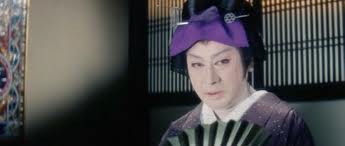
Ichikawa Kon’s masterpiece An Actor’s Revenge (雪之丞変化 1963) manages to add extra - and delightful - complications into any conversation about adaptation and fidelity. I won’t reveal too much of the story in case you haven’t seen it (yet!); suffice it here to make clear that there’s enough in the way of vengeance, fighting, corruption and betrayal for a good evening’s reconfirmation of our total depravity.

What Ichikawa adapted is a more complicated question than it might at first seem: created to celebrate actor Hasegawa Kazuo’s 300th screen appearance, An Actor’s Revenge adapts the earlier Yukinojo the Phantom (1935), with Hasegawa playing an onnagata (female impersonator) kabuki actor seeking revenge in both films. Further complications: Hasegawa had built a stage reputation for himself as an onnagata before he moved into cinema, and the earlier film being adapted was itself an adaptation of a newspaper serial. Further re-workings have followed, both in opera and, in 2008, in another film version.


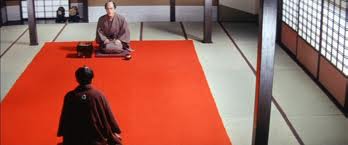
So far, so much in the tradition of complexity and borrowing adaptation brings along with itself; my interests in An Actor’s Revenge were provoked not so much by details or gestures to ‘fidelity’ at the level of story, but, rather, by more flagrant signs of their absence at the level of narrative discourse. Ichikawa plays up the filmic and cinematic by intense, dazzling experiments in colour. These stand as evidence, along with so much else, of what we’ve lost with the end of technicolor’s hegemony, and remind us that, for all the importance of kabuki and theatre at the level of story, the fact we’re watching a film, and the demands film makes in the narrative discourse, aren’t going to be self-effacingly minimized or obscured. Donald Richie’s Hundred Years of Japanese Film claims the clash of these two levels may in fact have been liberating:

The Yukinojo project also offered possibilities within the vast, uncharted realm of kitsch. Wada [who wrote the screenplay] found the original scenario so bad it was good, and kept almost everything. The resulting film is a tour de force of great virtuosity in which the director scrambled stage and screen, tried every colour experiment he could think of, and created one of the most visually entertaining films of the decade.

Is scrambling an altogether appropriate verb for indicating the sort of aesthetic work Ichikawa engaged in, though? The kabuki details are, to be sure, handled particularly neatly. Performances by Yukinojo (Hasegawa) act as narrative frames and stand as quite complex mise en abyme, while a certain stillness or stylized, ‘phrased’ acting reminds you of mornings spent in Kabuki theatres.


Those details, intensely pleasurable and intellectually provocative as they are in themselves, seem to me less important, though, than the frame breaking or well-nigh Formalist and estranging techniques Ichikawa deploys in bringing theatre and film into collision. There is, for starters, the matter of casting: Hasegawa plays both the onnagata Yukinojo and the Robin Hoodish Yamitaro the Thief, a doubling of a kind perfectly normal on the stage but disorienting in its matter of factness on screen. John Berra sees this as Ichikawa utilizing “every theatrical device at his disposal to enliven [the] narrative”, but isn’t the opposite energy at work? Don't the very theatricality of these devices point away from the theatre, towards the particular promise and energy of the world of film? Most striking, as evidence or example in that quarrel, is Hasegawa’s own body; revisiting a role he’d played close to 30 years previously, he’s a surprisingly plump, double-chinned, middle-aged and hairy figure to inspire, as he does, virtually suicidal love from Dobe’s beautiful daughter. Then there’s the camp sensibility (queer Japan yet again!) flaunting the conventions and laying bare the devices of theatre in front of the steady gaze of film. Namiji and Yukinojo’s chastely sexy love scenes, to my mind the best minutes in the whole film, even allowing for the audacity and glamour of the fighting, seem to send up both themselves, and their theatrical set of references.

What purpose behind these alienation devices? MacCabe reads high modernism as “in part a reaction to the new medium of film,” after which we see that “this new medium of film produces a new kind of adaptation.” Adaptation as reaction: we’re dealing with another case, perhaps, in which the relations of discourse are of the nature of warfare. An Actor’s Revenge has theatrical elements, naturally; these, though, against what some commentators may detect in them, serve an anti-theatrical purpose.


Fredric Jameson remarks of adaptation that

Only allegory can, I think, to justice to this unparalled historical situation, and I want to propose that individual works, either as external adaptations or as internal echo chambers of the various media, be grasped as allegories of their never-ending and unresolvable struggles for primacy. The novel, even when written for adaptation by film, necessarily wishes the latter’s eclipse and death, and seeks to demonstrate the debility of a medium that has to rely on a liteary ‘original.’ But at one and the same time film believe that its triumphant incorporation of the literary and linguistic hypotext into itself, in a generic cannibalism or anthropophagy, sufficiently enacts its primacy in the visual age (itself blissfully unaware of its stealthily approaching digital rivals). Such is the deeper allegorical sense of the encounters recorded here. (232)

An Actor’s Revenge could, finally, then, be read as a form of vengeance and historical triumphalism over the very form of acting and theatricality it seems so lovingly to represent and chronicle. Kabuki functions here in the same way as African artifacts displayed in a Victorian-era London study: they’re signs of film’s colonizing project, evidence of the claims film makes for its capacity to represent, mannerisms marking out the limits of a particular historical period.


Theatre in this film - both at the level of narrative discourse and, within the story, as detail, something for us to ponder whilst watching others watching - makes an anti-theatrical claim, standing as a rebuke to all those irritating moments in theatre criticism when we’re told in pious tones that theatre can’t be recreated out of its moment or context. Look, Ichikawa announces with all those flourishes of colour, and here it is again!


Given the cultural and political values supporting them, there’s no wishing away the questions of adaptation, fidelity and ‘truth to the spirit’. This isn’t to suggest that they’re questions that can be answered, though, or, following Bazin’s insight, that they make all that much sense as questions in themselves. Ichikawa’s genius in An Actor’s Revenge lies in his realization that, with adaptation as with so much else, attack is often the best, if not the only defense: the film version can live, in this logic, only after consuming the life of its rival in theatre.


Sources

MacCabe, Jameson, and Andrews’ comments are all from their chapters in the splendid new collection Colin MacCabe, Kathleen Murray and Rick Warner (eds.), True to the Spirit: Film Adaptation and the Question of Fidelity (Oxford University Press, 2011). I’ve also been reading Linda Hutcheon’s Theory of Adaptation (Routledge, 2006); after many years of relative silence on the question in the Anglophone world at least, adaptation is becoming a live topic once more.

I took some details of An Actor’s Revenge from John Berra’s essay “Vengeance is Mine: Authorship and Identity in Kon Ichikawa’s An Actor’s Revenge”, included with the MadMan DVD release of the film.

Friday, 27 May 2011

The Jargon of Authenticity


David Burton is most likely New Zealand’s leading food critic; whatever that exact status, it’s certain that his books and wide-ranging writing on food – deeply informed, careful, grounded in decades of research and careful reflection – mark him as a major figure in contemporary food writing in English. His eminence and exemplary status, then, offer reasons to read his works following what the narratologists call a symptomatic interpretation, looking for the ideological and political codes they unwittingly blurt out.


Burton’s prose – with its arch mannerisms, its laboured wit, and the carefully feigned casualness with which it constructs our image of the curmudgeonly implied author – offers suggestive images and fragments, clues to the ideology which it serves. In the era of what Mark Davis calls “the decline of the literary paradigm” and the rise of the celebrity chef, careful attention to the writing of food writing may present political insights of the kinds we used to demand from critics reading literary novelists. If Jamie Oliver’s Mockney gushing over the dishes he prepared for Blair and Berlusconi stands now as a record of one strain of New Labour’s elitist vulgarity, Burton’s concerns follow longer-term shifts in consumption and class society.

Burton’s highest accolade is that he finds food “authentic.” I started, after returning to Wellington last year, keeping clippings from each time his columns used the word, but it soon became clear how pointless the task was; the weeks when ‘authentic’ or ‘inauthentic’ didn’t appear were rare enough to seem remarkable in themselves. “Authentic” food is sometimes followed by checks on the racial purity and authenticity or otherwise of restaurant owners or staff: a piece in Cuisine magazine last year on Japanese restaurants noted sniffily that most of the owners profiled weren’t Japanese but instead Korean. Would we make the same background checks on Ford car dealers to be sure they’re all from Detroit? The racism inherent in the gesture (and one very rarely applied to New Zealand chefs trying their hand at different European traditions) goes all but unnoticed.


It makes perfect sense, of course, for a food writer to care about the quality of food and the coherence and flavour of dishes, but isn’t authenticity a particularly ill-suited sign under which to travel? Doesn’t the history of food itself – a history Burton’s own books do a great deal to reveal – reveal the cross-cultural, migratory, productively contaminating and inventive energy which comes from human travel and social interaction? Most of the time ‘authenticity’ is used as a marker to keep others out, or to insist on traditions with dubious roots and stability: it’s no accident that many of the most of what one thinks of as ‘typical’ Japanese dishes – okonomiyaki, say, or teppanyaki – date, in the form we know them, from the post-war period. A survey in the Japan Times a few years back revealed kare raisu, the Japanese take on an Anglo-Indian interpretation, as most readers’ ‘typical’ comfort food.


This is to say nothing in defence of food fads or ‘fusion’, but merely to note that ideas and flavours respect few borders: my favourite food memories from my time in Tokyo are of those meals which were the least authentic, those wonderful Japanese takes on Italian food, mushrooms and fish eggs stirred through pasta and then dressed with nori. Who’s to police what, and where?


Most advocates of “authenticity”, however, would react indignantly to being classed as gate-keepers and racial purists. Aren’t our eating habits and all those ‘ethnic’ restaurants a sign, as the argument goes, of our enlightenment, of the multicultural sophistication of the contemporary liberalism? The racist term “ethnic restaurant” gives that particular game away, and matches the exclusions supporting contemporary liberal thought. Are Pakeha so at one with the Universal they’re able to dispense with talk of their own ethnicity? ‘Ethnicity’ is fine as additional glamour and as a consumable lifestyle component, but it will be kept in very particular places, and its excesses policed.

A seemingly apolitical obsession with culinary ‘authenticity’, then, works in parallel with the kinds of ‘authenticity’ political multiculturalism authorises: activities which promote separation, distance, and reified cultural practices – the Multicultural Festivals so beloved of city councils the developed world over – are promoted, while vehicles for cultural communication, contact, blurring and exchange – the trade union movement, centrally, joint political struggle, the kinds of interactions working-class social and industrial life imply –are denied or belittled.

Slavoj Zizek has described multiculturalism as “the cultural logic of multinational capitalism”, and his remarks illuminate Burton’s obsessions:

… the ideal form of ideology of this global capitalism is multiculturalism, the attitude which, from a kind of empty global position, treats each local culture the way the colonizer treats colonized people—as ‘natives’ whose mores are to be carefully studied and ‘respected’. That is to say, the relationship between traditional imperialist colonialism and global capitalist self-colonization is exactly the same as the relationship between Western cultural imperialism and multiculturalism: in the same way that global capitalism involves the paradox of colonization without the colonizing Nation-State metropole, multi-culturalism involves patronizing Eurocentrist distance and/or respect for local cultures without roots in one’s own particular culture. In other words, multiculturalism is a disavowed, inverted, self-referential form of racism, a ‘racism with a distance’—it ‘respects’ the Other’s identity, conceiving the Other as a self-enclosed ‘authentic’ community towards which he, the multiculturalist, maintains a distance rendered possible by his privileged universal position. Multiculturalism is a racism which empties its own position of all positive content (the multiculturalist is not a direct racist, he doesn’t oppose to the Other the particular values of his own culture), but nonetheless retains this position as the privileged empty point of universality from which one is able to appreciate (and depreciate) properly other particular cultures—the multiculturalist respect for the Other’s specificity is the very form of asserting one’s own superiority.

Authentic Class Relations


For all the talk of authenticity, certain constants from the cultural ‘centre’ remain, and woe betide the waitress with English as a second language or an ‘accent’ (a review from 2002 moaned about the ‘sah-poons’ Burton was offered at Sakura Restaurant) or a restaurant with parts of its menu untranslated (last week’s complaint). These gripes – alongside the usual reviewer’s complacent moaning about standards of service – serve a crucial class function, interpellating us as the subjects of middle-class consumption. Again, the assumed accent-less status of the writer goes unnoticed; if others have ‘accents’, what status then for our own speech? Concerns about “poor service” – a term here covering everything from signs of underpaid and overworked exhaustion through to insufficiently obsequious competence – act to insist on a distance between diner and waiter, a distance for fantasy class investments and egotism.

The historian Ralph Samuel, writing almost thirty years ago on the cultural transformations Thatcherism worked in Britain, observed that

The new middle class have a different emotional economy than that of their pre-war predecessors. They go in for instant rather than deferred gratification, making a positive virtue of their expenditure, and treating the self-indulgent as an ostentatious display of good taste. Sensual pleasures, so far from being outlawed, are the very field on which social claims are established and sexual identities confirmed. Food, in particular, a postwar bourgeois passion . . . has emerged as a crucial marker of class.

Little has changed these last decades, and Burton makes explicit the links between his own project and its social audience:

To explain all this [the culinary renaissance], we may cite the breaking down of trade barriers and the consequent freeing up of imports; the impact of global fashions; and the information age bringing television cooking shows, cookbooks and magazines to a greatly expanded middle class determined to acquire the trappings of culture


One of the by-products of neoliberalism’s success has been that its key ideological foundations have, for many years now, been able to pass themselves off as outside the realm of the political, as common-sense, as universal truths of economic and social life. The tag-team roles of the main parties in the 1980s and 1990s in introducing the neoliberal order helped this process. What I’ve tried here is to suggest some ways that, when the topic is seemingly non-political, symptoms of that ideological process speak themselves. Food reviewing, perhaps, offers itself as political commentary in a way other, more ‘relevant’ discourses, find themselves unable to do.

And what am I having for dinner? Something inauthentic, of course, prepared by a cultural interloper. Just like everybody else.

Sources

Burton’s quote I’ve taken from his Biography of a Local Palate (Wellington: Four Winds, 2003), pp. 53 – 54.

Samuels’ lines are quoted in Alex Callinicos, “The New Middle Class and Socialists”, International Socialism, 1983.

The illustrations for this post are from two food-themed manga: Oishinobo, the classic food-critic manga, and Yakitate!, an odd wee tale about the quest for "Ja-Pan", the truly Japanese bread.

Wednesday, 18 May 2011

Shinjuku Boys


Yesterday was the International Day Against Homophobia and Transphobia (IDAHO). Friends and comrades of mine in Australia marked the day by taking part in speak-outs and rallies building the campaign for same-sex marriage. The Anglican Church in Sydney is trying to stop an important rally for LGBTI rights taking place this weekend, so this lead-up week must have a particular political and emotional force and charge. There were events in New Zealand too, and around the world.


One of the nice things about living in New Zealand again is being within a social formation where the movement has won a certain, enduring, space for lesbian and gay lives, and being able to enjoy the great benefits that brings to all of us. Particularly around where I live in Newtown, for reasons which aren’t clear to me (I fit here the cliche of the straight man for whom obvious social signals are a mystery), there are plenty of gay and lesbian couples living visible lives: as I walk to work each morning I pass a man kissing his boyfriend goodbye for the day, a gesture touching in its (I think calculated) combination of workaday normality and understated but significant physical bravery. This isn’t a tale of lives divorced from the working class, either, as one currently popular narrative in Labour Party circles would have it; these guys look like they’re on a budget, and their shoes show all the signs of regular use. There’s more to win – full marriage rights, for one – and nothing is permanent. Still, seeing two men kissing each morning is a nice, and educational, start to the day: plenty of heterosexual men (myself included) would struggle with that kind of relaxed emotional expressiveness, whatever the wider questions of sexuality. It hasn’t always been this way, of course, and it took a mass movement to win what freedoms there are. The activists in that movement took risks: as Bill Logan has written, “it was no rose garden, but it wasn’t a mistake.”

It’s the transphobia part of the international day I’ve been thinking about recently, though. I’ve learnt a lot, as I suspect plenty of others have too, from the issues that have been raised by the same-sex marriage rights campaigns in Australia and the United States, in particular around the struggles within these movements for the voices of trans people to be heard, and how their contribution to the struggle has strengthened its reach and energy. Sherry Wolf’s essay “To Riki, with respect” moved me, and set other thoughts in motion.

この道


I’ve written before about “this path”, the life of “this world” that is Queer Japan. Reading contributions around IDAHO yesterday, I remembered Kim Longinotto and Jano Williams’ excellent documentary Shinjuku Boys (1996).

Shinjuku Boys follows the lives of a group of onnabe working in The New Marilyn nightclub in Tokyo. The term Onnabe – the pun here plays on 女 – woman – and 鍋 – nabe, those lovely hot pots that make Japanese winters such fun and which demand a good deal of stirring and mixing – refers to women dressing and/or living as men and working in a “host” bar catering to women clients. Some are transitioning to new physical identities. The clientele are, in the main, heterosexual women, although many form ongoing emotionally and sexually intimate relationships with hosts they meet at the bar. The documentary, in allowing these people to speak openly and freely about their lives, is an intensely moving, educational, and inspirational work.


That last paragraph was difficult to write, and doesn’t communicate particularly well, because each of the terms I’ve looked to ends up proving as inadequate as the one it replaced. This difficulty mirrors the limitations in my political vision the film helped expose. First time around, with well-meaning bafflement, I spent most of my time trying to fix in place precisely what couldn’t, and shouldn’t, be fixed: who were the men? Who were the women? Were any – or all – of the people interviewed lesbians? Which people lived as women? Which wanted to be men?

This line of questioning, apart from being a particularly rude and unpleasant way of talking about other people, is politically unhelpful, and Shinjuku Boys helped me see why. That the labels of sexuality, gender, and, oftentimes, sex itself didn’t fit for many lives was, for the interviewees, a given: things became difficult when other people (and, through them, social forces) tried to make them fit, with sometimes tragic results. Some onnabe were happy, others unhappy, much like the rest of the world: what they shared in common, though, was a determination to live the kind of life they wanted to live. A good aim and, if the social fixations, expectations and clothing- and genital-attractions of each of the sexes didn’t fit so well, bad news for those expectations.


Shinjuku Boys, in giving its commentary over to the subjects of the documentary themselves, forced me to confront complexity. These people’s frankness about identity, sex and sexuality was also a reminder of the importance of respect and privacy, of the sorts of conditions necessary to make political conversation possible: you can’t learn about other people’s lives or needs by demanding easy affiliations from them. The power of unity in struggle is, among many other things, the power of being different. That’s difficult, and needs working at, but I’m sure it’s essential too.

O wad some Pow'r the giftie gie us
To see oursels as others see us!
It wad frae mony a blunder free us,
And foolish notion:
What airs in dress an' gait wad lea'e us,
And ev'n devotion!


The struggle continues: I was very pleased to see the first openly gay candidate win public office in Japan earlier this year. Socialist Ishikawa Taiga marches on May Day, campaigns for AIDS awareness, writes thoughtfully on gay life and has opinions on US bases. (The hint here, again following right-wing commentary on the state of the NZ labour movement: it’s possible to multi-task).


Here in Wellington next month we’re going to march to “Queer the Night”, a sign of LGBTI pride, and against homophobic violence and threats.

So, let's rock society!


Sources

Most of the best political and social websites coming out of the Japanese lesbian community start with pages asking men not to view or enter them. Fair enough. I’ve respected those requests and won’t read or link to them, but want to record their absence here. If you’re a woman reading this you might like to explore further.

In keeping with the international day being about action and education, I'd like to acknowledge the extraordinary education in sexual politics and LGBTI history and struggle through my time in Socialist Alternative when I lived in Melbourne.

Friday, 6 May 2011

Australia's Pacific War


Part of the great ideological power of ANZAC Day now is the way it mobilises imagery stressing the pity and sorrow of war in order to strengthen militarism and Australia and New Zealand’s military role in the world. Few events grant the armed forces such opportunities for public display and social legitimacy; fewer still so successfully de-politicise the discussion of political questions. When Marilyn Lake and Henry Reynolds brought out their collection What’s Wrong With ANZAC : The Militarism of Australian History last year, they faced sustained hostile commentary from both the liberal and right-wing press. In New Zealand it’s taken a legal battle right through to the Supreme Court to establish that free-speech principles stand on April 25th.

The event’s power is recent, and remarkable: baby boomers I’ve spoken to marvel at the transformation of the unpopular, poorly attended and jingoistic events of their youth into the well-nigh universally marked dawn services of today. Part of this appeal is no doubt to do with the passing of the generation who fought in World War Two – I remember that as my own half-formed justification when, as a teenager, I turned out in Queen’s Gardens – but, whatever our individual and complex emotional feelings about loved ones and relatives, the political and social consequences of ANZAC Day’s revival are everywhere evident, and damaging.

This ANZAC Day I was flying home from the Marxism conference in Melbourne, an event where I’d been lucky enough to be able to attend the launch of Tom O’Lincoln’s new book Australia’s Pacific War: Challenging a National Myth. This book is an excellent, and sorely needed, corrective to the nationalist and pro-war mythology bolstering Australian military and imperial ambitions, and informing the cultural work on ANZAC Day – Australia’s Pacific War is an anti-war counterblast, a critical account of how Australia and its allies fought in the Pacific theatre of World War Two.


The Pacific War has a particular significance in the mythology of contemporary Australian imperialism: for all the drunken revelry of backpapers taking time out from their OEs to worship at Gallipoli each year, World War One offers slim pickings for today’s apologists for war. Widely accepted as an exercise in bloody futility, distant, confused; the First World War serves too easily in the anti-war narrative for the right ever to have bothered much with its reclamation. (The grubby role of Australian and New Zealand troops propping up British colonialism doesn’t help here either: characters in Naguib Mahfouz’s Cairo Trilogy use the term “Australian” as a catch-phrase for abusers, pillagers and thugs). Against this, Australia’s actions in the Pacific can be connected to myths of the Second World War as the “good war”, for Australian independence against Japanese aggression, for freedom and democracy, for liberty against empire. It’s a myth which has suited many an imperial venture since.

“What I mean by the Pacific War myth,” O’Lincoln explains, “is a mass phenomenon, in which an elaborate belief system sustains social mobilisation…Instead of a fantasy of inevitable victory, we find a fantasy affirming the inherent validity of national war mobilisation – a national myth that underpins war-making today.” (viii). Replacing older, cruder myths of “inevitable victory” is in part what gives ANZAC Day its ideological force: mourning and recognising the dead, now, provides unwitting support for the set-up that ensured their death.

Australia’s Pacific War sets out an historical record very different to that the myth of the “good war” encourages us to imagine. Australia was never under threat from a Japanese invasion, and its rulers knew this. The fear of that invasion, though, was cleverly developed and exploited by the Labor government of the time to justify and extend war policies abroad and industrial exploitation at home. (Labour’s vile role suppressing civil liberties in both Australia and New Zealand deserves more attention: see, for NZ, Russell Campbell’s documentary Sedition).


Drawing on racist campaigns against the Japanese of long standing, Australia’s media and political forces used the war to whip up popular loathing and a de-humanising of the enemy. Where anti-Nazi propaganda focused on Germany’s leaders, anti-Japanese material was generalising, and deeply racist. O’Lincoln quotes from an article on “The Japanese as a Fighter” in the Melbourne Argus :

He was a mass of contradictions – he fought grimly, enduring terrible wounds, until he was destroyed; or he ran in screaming fear; or he blew himself to pieces with a grenade clutched to his chest or stomach. He was cruel and dirty and bestial. He killed his wounded rather than have them fall into our hands. He plundered and raped the natives. The Australians and Americans came to loathe him as one loathes something that is dirty and ratlike.

And this appeared after the bombing of Hiroshima and Nagasaki! Politicians exploit this set of associations still; O’Lincoln quotes Alexander Downer in the early days of the “war on terror” referring to “monsters such as Hitler, Mussolini and Tojo.” Even George Bush himself wasn’t as capacious in his genealogies of the Axis of Evil.


Australia’s Pacific War details the Australian army’s role in sustaining British – and Australian – colonial domination in the Asia-Pacific region; Australia’s invasion of East Timor; racism in the occupation of the Japan and repression of the Japanese labour movement; and the impact of the war on democratic liberties and class struggle at home. Life for people in colonised countries under Japanese rule could be very unpleasant: in this, it differed little from life under any of the other competing colonial forces in the region. O’Lincoln quotes from a diary of an Australian soldier:

The private local war [in East Timor], Portuguese versus native, still goes on in its bloodthirsty way, and provides some humour for sub units. One of our patrols near Mape, out hunting the Jap, encountered a Portuguese patrol out hunting some natives, they exchanged compliments and went their various ways.

This all makes for grim, but important, reading, but Australia’s Pacific War isn’t just a chronicle of war’s horrors. O’Lincoln includes chapters on unrest on the homefront – industrial unrest, certainly, but also changing attitudes to gender and sexuality – and considers some of the experience of ordinary soldiers in Japan, and how these human encounters changed their attitudes and actions. There’s plenty on the ongoing resistance of indigenous people – in Australia and in colonies abroad – to the treatment they received from occupying forces.

Australia’s Pacific War is written to “challenge conventional views of the war.” I hope it does.

Sources

Tom O’Lincoln’s website has some excerpts from the book, as well as supplementary material on questions it raises – on the (compromised and occasionally horrifying) position of Communists in Australia towards the war, on labour in the war, and more.

ANZAC Day has been a site of social conflict and contestation as well as forced unity: read Kyla Cassell’s very good article here (PDF) on class conflict at ANZCAC Day celebrations between the wars.

ShareThis