I'll ha'e nae hauf-way hoose, but aye be whaur / Extremes meet - it's the only way I ken / To dodge the curst conceit o' bein' richt / That damns the vast majority o' men.
Buoyed by good news this morning from the campaign in Australia for equal rights for same-sex couples, I want to share a detail from a detailed and rewarding book I’ve discovered. Mark McLelland’s Queer Japan from the Pacific War to the Internet Age is a rich layer-cake of analysis, history and examples from “this world” (この世界), the diverse communities of queer Japan.
McLelland’s two main scholarly-political points have relevance beyond Japanese studies. Sexuality doesn’t work to a timetable, whereby countries like Japan can be chided for being niggardly in ‘catching up’ with the West and its putative Enlightenment (something of this is used, with greater or lesser degrees of shame-facedness, in the liberal defense of murder justifying the war on terror). Instead,
Japan was never a passive recipient of western influence. The Meiji period did not see the sidelining of original or authentic Japanese sexualities by new notions imported wholesale from the west. Rather, sexuality was constituted through a highly complex and contested process in which traditional terminologies were continually being overwritten by new meanings and in which foreign loanwords and ways of knowing were strategically redeployed to serve local uses. (221)
Secondly, the proliferation of discussions about and explorations of sexual minorities, identities and subjectivities in the ‘perverse press’ of the post-war period in many ways anticipates queer theory’s emphasis on social construction, fluidity, and sexual stories over fixed identities.
この道
Walking ‘this path’ (この道), then, is not so much about catching up with a solid Western identity as it is about negotiating – and struggling over – how sexualities are forged within a given social formation. “Globalization,” McLelland argues, “results in creative indigenization and cultural admixture much more than it does in any unilateral imposition of western sexual identities.” (221)
Intriguing here are the relations between the fixing of names – a vexed enough process anywhere – and the act of translation. McLelland maps out the genealogies and differences between homo, homosekushuaru, gei, okama, bian, rezubian and rezu, each identity position shaped by and shaping a particular historical and social moment.
The history of “gay” as a term in Japan is particularly interesting. Now used much in the same way as it is in English-speaking countries, gay as a loan word fed into older Japanese discourses of sexuality. The katakana loanword ゲイ is a homophone of the kanji 芸 – arts or artistic accomplishment, used as in geisha – and so the term gei boi from the post-war period had connotations of both the “gay boy” and Tokugawa-era sexualities and patterns of same-sex desire. “Gei boi (homosexual)”, McLelland points out, “elides into geisha boi (entertainer), such that the stress is not on sexual orientation so much as artistic performance.” (110).
[But don't you know that we've changed so much since then / Oh yeah / We've grown]
Impatience with these definitional complications can have damaging effects on people’s lives, as McLelland’s chapter on transgender identities makes clear: to see oneself as a nyuuhaafu or transgendered is quite a different matter from accepting a diagnosis of “gender identity disorder” (sei douitsusei shougai) and the rigid definitions and stigmatisation that label brings. The limits to our ability to self-create and self-define and negotiate our sexual identities are the limits of our homophobic and heteronormative social formations: whatever the inability of the terms ‘man’ and ‘woman’ or 男 and 女 to encompass the range of human gender identities and bodies, the patriarchal power of the family register and the law’s definitions shape us in ways we’re unable to fully resist or avoid.
So, as always, there’s work still to be done. Walking this path is about discovery, and it’s also about struggle.
Further Reading
McLelland edited a special issue of Intersections on Queer Japan in 2006 which is full of fascinating articles. An earlier article of his on Orientalism and coming out narratives is also well worth your time. You can order a copy of Queer Japan here.
The Chase is a fairly unremarkable middle-class street off a fairly unremarkable stretch of parkland on Clapham Common, and all that unremarkable clean drabness suited my purposes perfectly last week. I was visiting the Sōseki Museum, an intriguing site of non- or anti-experience.
The Museum is a weirdly precise reminder of the impossibility of the immediate, literary tourism turned into its opposite, quantity into quality, a recreation of Sōseki’s London showing no such thing exists, a monument to anti-travel. I mean none of these terms to disrespect Tsumematsu Ikuo, the Museum’s founder and funder; his love and effort are apparent in each detail and item, and the staff member at work when we visited was friendly and helpful. But it’s this sense of missed experience that’s stuck with me from the visit, an uncanny play between the objects and the world they recreate. Doublings, traces: the mediated memory of Sōseki’s London produced by the Museum finds fascinating – for me, anyway – echoes in his own work.
For starters, this is a shrine to Sōseki that acknowledges its own artifice and construction. It’s the Sōseki House but not the Sōseki House, which is across the road. The books are Sōseki’s but again not his, being identical editions bought reconstructing reading lists the author kept. A Sōseki shrine in London is ironic in obvious ways, too, when we remember how much he hated the city: “I lead a most miserable life amongst the English and felt like a dog thrown into the company of wolves.” We come to Sōseki’s London through his writing, where one of his most memorable stories considers the Carlyle House, now host to a disproportionate number of Japanese visitors, “lured by Sōseki’s mystical depiction” [Flanagan, 160].
Sōseki’s London tales are some of the greatest works of metropolitan Modernism, detailing the bewildering and destabilizing effects of anonymity and mass urban life, the dislocation of the subject amongst pictures wearying out the eye and “unmanageable sights”, but of course – as Damian Flanagan points out – these dislocations for us now provoke images of Tokyo far more than the sleepy affluence of Clapham. The Museum guide offered me large-scale reproductions of Booth’s famous social maps to add to this sense of dislocation (Franco Moretti on Booth: “it is the confusion evoked with fear and wonder by most London visitors; confusion, in cities is always a problem”).
The confusion here, though, is in traveling to last century’s London in order to imagine today’s Shinjuku:
Last night, throughout the night, I heard a pattering echo above me pillow. This is thanks to having the great station of Clapham Junction in the neighbourhood. In the course of a single day, over a thousand trains crowd into this junction. If one tries minutely dividing that, it means that about one train comes and goes here every minute. In times of deep fog, each train signals that it is on the brink of entering the station by contriving to rise a firecracker-like noise. [Fog]
The Museum’s recreation of Sōseki’s lodgings, its doubling of across the road, recreates something of the sense of anonymity and urban loss the prose worries around:
As I walk along, I recall the houses I have just left. The strange street, with the same four storeys and the same colour everywhere, seems somehow distant. I feel like I would have no idea where I should turn and which way I should walk to get home. Even if I did get back I probably would not be able to pick out my own house. Last night the house had stood in the midst of utter darkness. [Impression]
I felt a silly excitement handling these books: how great that Sōseki liked books I like!
Or, if not books I like, then books folk I like liked, such as Burns’ favourite Man of Feeling.
A more uncomfortable and unwelcome personal echo, though, when I learn from Flanagan that social nervousness made Sōseki convince himself that buying and reading books was a better use of his time than socializing or getting to know Londoners (“Over a two-year period he appears to have spent a third of his entire salary on books and bought as many as five to six hundred volumes, all crammed on to the shelves, table and floor of his boarding-house room until he could ship them safely back to Japan with him” Flanagan, 13).
Stranger doublings and echoes again in these examples of Japonisme.
Within them Sōseki may well have read examples of the clichés and Orientalist tropes which would come to dominate the Western imagination’s approach to Japan.
Sent to England in order to engage in intensive study of English Literature, Sōseki returns with all sorts of items bearing with them the mark of those first contacts in the Meiji Era.
This journal, which Sōseki subscribed to up until his death, was particularly beautiful.
There’s a fascinating article by Chris Gosden at Material World, which argues that “museum objects to some degree conceal the mass of relations that lie behind them, ranging from the people who originally made and used the objects, to all parties to their trade and transfer and ending, for now at least, with the curators, conservators and visitors who make up the museum community in the present” and which makes the case for a new kind of relationship and Museum.
The Sōseki Museum attempts none of that; these are items for the fiction of a preserved moment. What makes it uncanny, then, is the way these relations are submerged so deeply that, like the man digging his way to China, they somehow appear out on the other side: a writer on London’s past sets you thinking about Tokyo’s present, a shrine to immediacy sets off thoughts about mediated memory, a writer whose work ironises journeys to the House of a great writer finds his own hated lodgings turned into a site for similar tourism.
And some other things never change:
Sources
All quotes are from Damian Flanagan’s translated collection The Tower of London (Tokyo: Tuttle, 2005). Flanagan’s long introduction is an excellent, and detailed, contextualisation of Sōseki’s London work. He’s a neat proselytizer too (Sōseki’s “a finer writer than Tolstoy, Proust, or Joyce”).
The Moretti quote is from p. 78 of Atlas of the European Novel 1800 – 1900 (London: Verso, 1998).
Like the stream, time, gently, little by little, goes by
Two funerals from twenty-one years ago, both consumed then and now as quintessentially ‘Japanese’ moments. The Shōwa Emperor and Misora Hibari, high culture and low populism, national essence and national sentiment, both representing tradition and unique qualities, matching one another as sites of national memory and mourning.
The tragedy of Misora’s early death – she was only 52, and still a powerful performer – and her life story of poverty and struggle make this mode of consumption all the stronger. Hard times – and the upbeat attitude and determination of the ‘Tokyo Kid’ – were one of the truths of the Shōwa era, and, amidst the desolation and frenzied transformation of the post-war Japan, it’s easy to see how the perfectly pitched nostalgia of Misora’s music created its audience.
Still, something’s missing. There’s more work with memory to be done, more effort needed.
To live is to journey, searching for the dream world
Love, and awe at such beauty, were my initial responses, and they remain my main feelings about her music. That quavering, almost failing sound the best enka singers battle with Misora manages to push further than others, and to add to it a roughness, a strength and precision of sound I find, more and more, moving. She does wonderful things with what Barthes calls ‘the grain of the voice’ and, instead of working on the stage expressiveness of the pheno-song and its ‘meanings’, Misora’s art is of the geno-song,
the volume of the singing and speaking voice, the language where significations germinate ‘from within language and in its very materiality’; it forms a signifying play having nothing to do with communication, representation (of feelings), expression; it is that apex (or that depth) of production where melody really works at the language – not at what it says, but at the voluptuousness of its sound-signifiers, of its letter – where melody explores how the language works and identifies with that work.
I hear Misora when reading Barthes’ lines on the erotics of ‘the tongue, the glottis, the teeth, the mucus membranes, the nose,’ the jouissance of the grain of the voice. (This, incidentally, is why Kim Yon Jya, whom I usually admire, is so unwise to issue recordings of 川の流れのように: her emotionality and attempts to ‘communicate’ the material, so often effective, have here to compete with the listener’s aural memories of Misora; the effects are damaging).
With these feelings I’m hardly alone: sometime during the 1990s ten million people voted 川の流れのように the great Japanese song of all time.
I find myself to have been leading a life without even a map for guidance.
It’s that status as the great ‘Japanese song’ which suggests productive – and political - comparisons between the cultural events of the passing of the Shōwa emperor and Misora’s death. We consume the imagery and spirit of both figures – and the cultural logic of what they’ve been used to found, solidify, set in motion – in particular and determinate ways, ways that point to how the post-war settlement sustained itself.
In a short-hand version: it’s important, and far from accidental, that the greatest Japanese performer of all time was Korean.
Takayuki Tatsumi argues, in Full Metal Apache, that the Shōwa Emperor was “the ultimate cyborg, [who] constituted the essence of postwar Japanese body politics.” His transformation into from religious officiator to gentleman general to dapper chap through to virtual salary-man matched the shifting positions of Japanese capitalism and its self-presentations and, if the famous photo with McArthur represents one moment of national humiliation, each further photo imaged and staged how national rebuilding and repositioning was to look. After the initial post-war years of social upheaval and chaos – mass rallies on May Day, a Communist Party ascendant, riots and street battles in Ueno – the Shōwa Emperor is ‘reprogrammed’ into a new mediated, cyborg body politic formed by US and ruling-class Japanese interests: ‘pure’, stable, national, ordered, timelessly Japanese. His image tracks a political project of exclusion.
Isn’t Misora the presence shadowing this process, its Other somehow hiding in plain sight? Isn’t her Zainichi status – like Rikidozan’s when he redeemed Japan in the pro-wrestling boom - the obscene supplement, her music excess to the Shōwa Emperor’s superego?
It’s not just that she was Zainichi, a Korean, even though that does matter and is enough to enrage many a Japanese nationalist and xenophobe (cf here the appallingly racist ‘debates’ on her ethnicity at her Wikipedia entry). That biographical detail matters, naturally, and its erasure from public commemoration and celebration is an indictment of official Japanese racism. What’s more intriguing is how, like the Shōwa Emperor’s ‘cyborg’ transformation, Misora’s Zainichi, outsider status was precisely what enabled her to take part in the creation of the ‘typical’ Japan for which she is now remembered. As John Lie argues
She became the prototype of all idols (aidoru) in postwar Japanese culture. It would not be an exaggeration to say that Misora personified what was ‘authentically Japanese’
Personification: again, like the Shōwa Emperor, there’s something about the ideology and mystique of bodily representation at work here. Misora’s life as an actual human being fits very uncomfortably with the mediated memory of her as the image of Japanese ‘Misora Hibari’: the racism and poverty her Zainichi family experienced would make her childhood unrecognizable to many, and her persecution by NHK for her brother’s alleged gang connections kept her for many years from taking part in the Red and White Song Battle, surely the marker of a singer’s status and presence. There’s bad faith, naturally, in her current veneration. (That bad faith, incidentally, isn’t without its own unitended ironies: the last time I was in Nagasaki I saw a Misora Hibari-themed pachinko game, nicely eliding a Zainichi image mainstream Japan can’t acknowledge as Zainichi with a vice of its own it can’t stop from associating with Koreans).
Her role in the creation of a unique Japan goes deeper still; as Lie argues, Enka, which reached its peak of popularity as Misora reached hers, so often presented as the ‘quintessential’ Japanese musical form – with Misora as its quintessentially Japanese practitioner – draws on and relies upon elements of Korean traditional music and European light music, to say nothing of the many Korean and Zainichi Enka stars who populate its top ranks.
Without knowing it I have been walking along a long and narrow path
A number of historians – Sakai Naoki and John Dower among them – have produced work in recent years arguing that our image of Japan as a monocultural society is a product of the post-war period, and that the reality of human interaction and culture on the archipelago is a much messier one than this image allows.
What’s striking, though, from a view to the history of culture, is how important outside elements have been to this monocultural self-presentation. From Rikidozan to Misora, the cultural monuments of Shōwa Japan are ‘Korean’ as much as they are ‘Japanese.’ There’s an anxiety to the nationalism and xenophobia of the Shōwa era, an excess to its exclusions that demonstrate their futility and falsity. It’s wholly appropriate that Misora Hibari provides the soundtrack to those gestures at the same time as she undoes them.
Looking over my shoulder toward my home village far away
Those scare quotes a paragraph ago aren’t, I think, an academic affectation: part of what’s useful in remembering Misora’s story now is the chance she offers us to unpack national certainties. There’s nothing to be gained if we replace Japanese ‘ownership’ of this great singer with Korean ‘ownership’, as in the DPRK biography of Rikidozan entitled I am a Korean!, an anxiously insecure move if ever there was one. South Korean nationalisms have been as unjust towards Zainichi experience as Japanese ones through the years and, under the Park dictatorship, some forms of traditional Korean music sounding like enka were banned for their suspect debts to Japan.
Lie is closer to what I think is important when he writes that “national purity cannot be found in music, sound does not respect musical borders.” The grain of that voice makes a first, distancing or clarifying, appeal.
Misora remembered this way might also re-position her in our thoughts for the future. It’s not that Misora doesn’t ‘belong’ to her Japanese fans anymore, or that her unacknowledged Zainichi heritage changes its place in Japanese culture, memory and nostalgia. The hope, rather, is that we might highlight how that Zainichi place has always been there, and how it might offer a position from which to move beyond the sterile (and US driven) nationalisms of the region. This is partly, to be sure, a question of acknowledging multiplicity and reality, partly also a chance to imagine new political positions and loosened loyalties.
The most insightful comments on that possibility I’ve read so far come not from a philosopher or a singer, but from a footballer, DPRK striker Jong Tae Se:
"My homeland is not Japan. There's another country in Japan, called Zainichi, [and] none of these countries - South Korea, North Korea and Japan - can be my home country, because I'm a zainichi and therefore Zainichi is my native land."
That ‘native land’ is nowhere, and the richer for it. What’s so moving about Misora Hibari’s art, the precision in the grain of her voice, is the way it inhabits that impossible land.
Sources
Roland Barthes, ‘The Grain of the Voice’ in Image-Music-Text, trans. Stephen Heath (London: Fontana, 1977).
John Lie, Multicultural Japan (Cambridge: Harvard University Press, 2004).
Takayuki Tatsumi, Full Metal Apache: Transactions Between Cyberpunk Japan and Avant-Pop America (Durham: Duke University Press, 2006).
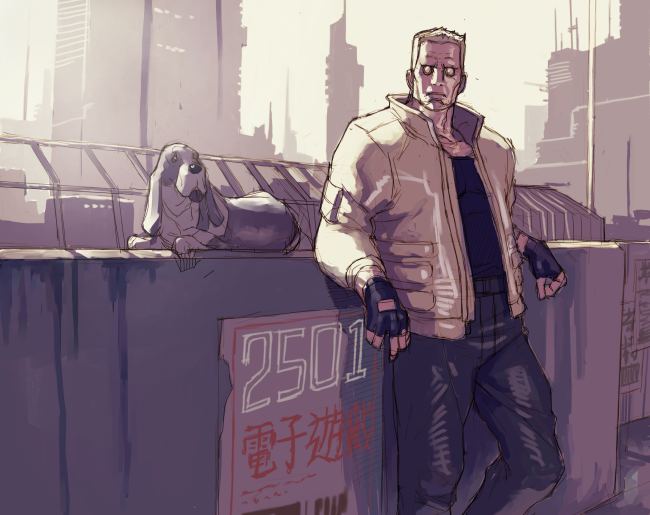
Matthew Stoddard’s essay on Ghost in the Shell, cognitive mapping and the ‘desire for communism’ is well worth reading. It’s very clever and thoughtful and good fun, and nicely complements Amy Shirong Lu’s insightful “dialectic reading” of Oshii’s work as containing both an old ghost and a new shell: the ‘new shell’ all our favourite option, the posthuman future and its political potential (“I would rather be a cyborg than a goddess”), its ‘old ghost’ those stereotypes of maternal function and nurturing which follow images of the female.
Stoddard’s essay reminded me of two questions that stuck in my mind after first seeing Ghost in the Shell (and I’m referring only to the 1995 film here; the manga and Innocence have their own relative autonomy and, for reasons which will become obvious through the post, I won’t watch the misguided CG folly of Ghost in the Shell 2.0).
Firstly, when did Tokyo stop being the future? There’s a politics to the associations of dystopia and China here, of course, but I don’t think it’s enough (or the main politico-aesthetic question, as I’ve argued before about Code Geass) to point in that direction. There’s a post-Bubble aesthetic sorting itself out here; worth wondering what follows on.
Secondly, how does the video imagery of Ghost in the Shell fit with Stoddard’s comments on memory? The connections between the film’s philosophical and posthuman or postmemory ambitions and its strategic use of perspective, surveillance and recording are obvious, sure, but it’s the video part of all that which is so striking. It’s not so much that these devices are dated now, but that they do the work of being troubled by the idea of mediated memory and mediated identity and subjectivity in very different ways to how digital recording and technology does when given similar chances in more recent anime. In one sense, naturally, Ghost in the Shell’s work here – messing with our longing to separate those long mystical moments against the puppet master plot and the fashioning of the robots – is familiar. As Giovanni Tisoargues:
“The seemingly opposite and equally apocalyptic visions of amnesia and hypermnesia, of a crisis of memory and of total recall, endlessly projected by consumer culture, stand in a complex relation which is reciprocal and inclusive as opposed to antithetical and exclusive.”
It’s the damage of transmission in video – the introduction of new material and ‘distortions’ which render an original impossible and a copy new – that seem to carry so much weight in Ghost in the Shell, and to be used to prompt reflection. Kinks, bends, flickers: all these features serve to draw our attention to memory’s mediation, and to point at the plot line covering memory’s crisis and reproduction.
From this distance, though, don’t they look much more like memory’s calling cards, its material traces? Used as we are to forms that stop before they ‘age’ (the DVD left in the cupboard that then stops playing; the memory stick which doesn’t function after coming out the wrong side of the wash cycle; the file corrupted between computers), these earlier images of memory’s vulnerability and malleability come over to us as something like memory’s resistance. When considering aesthetic devices and explorations I think Ghost in the Shell’s effort at mimesis of imperfect recording and flawed or ‘damaged’ perception marks it out as important to consider in any treatment of the development of narratives of the crisis of memory. Quite what that importance is I’m not able to tell you – sorry if you read this far in the hope of a momen’t wisdom – but Stoddard reinforces my sense I’m right to feel it’s there.
You may fasten my chains Deprive me of my books and tobacco You may fill my mouth with earth Poetry will feed my heart, like blood It is salt to the bread And liquid to the eye I will write it with nails, eye sockets and daggers, I will recite it in my prison cell - in the bathroom - in the stable - Under the whip - Under the chains - In spite of my handcuffs I have a million nightingales On the branches of my heart Singing the song of liberation.
[Translation taken from Our Roots Are Still Alive: the Story of the Palestinian People (New York: Institute for Independent Social Journalism, 1981), p. 137.]
Thanks to friends in Kakehashi / JRCL (日本革命的共産主義者同盟) for the photo.
The first player to produce an accurate copy of a recent news article on the Korean peninsula would then be announced winner. This game – as well as testing your wits with combinations – would save you the bother of having to read whatever article is was you’d managed to copy that round.
Either way, you’d be unlikely to come out any more ignorant of the situation than you were when you went in. Recent events remind us yet again how uninformed most commentary on Korea is, how warped and distorted by the needs and viewpoint of the US, hardly a neutral player in the region, and by its interests.
That’s an old gripe, though, and one for which there’s no easy remedy. Amidst all the tough talk from Clinton, Obama and Hatoyama, it’s easy for small facts to get missed: the sinking of the Cheonan led to more pointless and tragic loss of life as a result of the division of the peninsula. This isn’t mysterious loss, though; it’s connected to the history of that division, and the US and its imperial interests’ role in that division. History is a submerged and denied zone in almost all commentary on Korea. As Bruce Cummings comments:
And this particular incident is just ripped out of context, the context of a continuing war that has never ended. Just an armistice holds the peace. But in the case of this particular incident, which happened very close to the North Korean border, we’ve had incidents like this, somewhat different ones, but with large loss of life, going back more than ten years. In 1999, a North Korean ship went down with thirty sailors lost and maybe seventy wounded. That’s a larger total of casualties than this one. And last November, a North Korean ship went down in flames.
I often hear journalists refer to the two Koreas as ‘technically’ still at war, as if this were a mere detail standing in the way of real life’s realities. But it’s hard to see technicalities in divided families, lost lives, and occupying forces.
So far, so familiar, though, yes? The mainstream media occludes history and narratives of power; one can alwayslookelsewhere. What this latest episode in Korea’s long unhappiness illuminates, though, are more widespread blockages to thought. Reports from the surface and analyses of the depths throw certainties back and forth between each other, and these certainties stop more difficult questions getting asked.
Heart of Darkness on the Taedong…
Mention the term imperialism in some well-educated quarters and – even given the events of the last decade and the revival of anti-imperialist scholarship provoked by them – you’re likely to encounter rolled eyes and polite silences. What the term names, for all that, is an attempt at understanding the dynamics of this current system, its needs, where they came from, what their trajectory might be. Attending to that reality involves grappling with complexity, and real historical difficulty; substitutes for that difficulty are alternate reductionisms in the search for a regime’s ‘essence’ or the political theology of totalitarianism.
Guy Delisle’s acclaimed graphic novel Pyongyang sets itself the task of studying “one of the most secretive and mysterious nations in the world today.” Delisle spent some time in Pyongyang working for a French animation company and Pyongyang is a memoir of that time. The personal narrative is illuminating in its way, but Delisle provides his study of “the surreal showcase city” with an interpretive frame that offers pre-prepared answers to his questions:
He arrives with a copy of Orwell’s 1984 – excerpts from which provide commentary through the novel – and, in doing so, inserts his own work into that longer story of Cold War readings and (mis)uses of Orwell’s text for political purposes quite foreign to its author’s own anti-imperialist vision. Pyongyang’s North Korea, then, isn’t investigation but illustration: the ‘totalitarian’ thesis provides a ready-made vessel in which to contain the text’s narrative. The wider question – whether the story of one personal and atypical experience can take the strain of the peninsula’s historical and political complexity – is never asked, so confident is the text in its assumption (signaled by Orwell’s arrival on only the second page) that the white, Western subject’s putatively non-ideological ‘experience’ will convey the truth with which it arrived pre-prepared.
Mads Brügger’s Red Chapel, a documentary in the tradition of Sacha Baron Cohen’s Borat, uses a similar ‘totalitarian’ frame. For Brügger the DPRK was one example among many of the species dictatorship, and his film would demonstrate its typicality. “I knew that I had to offer them comedy, because dictatorships are really bad at handling comedy,” he told an interviewer. “All dictators are basically laughable, especially Kim-Jong Il.” Not only is its leader “laughable”, its people aren’t fully human: “it’s very difficult for them to handle human emotions.” Perry Anderson’s comment that “self-satisfaction is scarcely unfamiliar in Europe” has rarely felt more pertinent. Brügger laces his film with inanities and commonplaces (this is “the most evil regime on earth”, the “heart of darkness”) and strange historical assertion: the heart of the regime’s lie, he informs at one point, is that it claims the US started the Korean war when in fact it was itself responsible.
The audience I saw The Red Chapel with during Wellington’s International Film Festival loved it. They laughed uproariously at all the moments of absurdity, and film and audience matched each other in a perfect fit of call and response. Look for a laughable country and you’re bound to find one.
It was that laughter that’s stuck in my mind in the months since seeing Brügger’s film, and a sense that it is the connection between Delisle and Brügger’s work and the superficial mainstream media accounts they claim to go beyond. What’s remarkable about both works is that, for all their claims to unique and privileged access to Truth (“one of the few Westerners to witness…”), they both show us what is already on display. The Red Chapel’s ‘exposure’ of the Juche idea recounts what anyone who reads the North Korean press or other publications can find for themselves. And are these sights – mass rallies, eerily empty streets, propaganda posters and pollution – really able to stand in as revelations of the place’s essence? Rather, it seems to me, these are the stock images of the North, produced as much by mainstream media as, from time to time, by the DPRK itself. Without some attempt to consider how the area got into the situation it is in now – without, in other words, a project to make sense of his material – Brügger’s ‘answer’ that things are laughable can offer no more than empty gestures and shrill moralism. Besides, if that surreality is so often on display, it might be worth pondering something that never occurs to Brügger, whether there’s a logic to the material before us, reasons which might demand reflection. Against Brügger’s claim to have found the ‘laughable’ heart of the regime, consider Slavoj Zizek’s comments on the Marx Brothers’ masterpiece Duck Soup. Against readings of Duck Soup that inscribe it as ridiculing totalitarian state rituals, exposing their fear of laughter, Zizek contends:
The powerful effect of Duck Soup does not reside in its mockery of the totalitarian state’s machinery and parephenalia, but in openly displaying the madness, the ‘fun’, the cruel irony, which are already present in the totalitarian state. The Marx brothers’ ‘carnival’ is the carnival of totalitarianism itself.
The ‘secret’ or hidden story of the DPRK The Red Chapel brings back, in this logic, is the state’s very self-presentation, images anyone can find if they turn their attention that way.
History is what hurts…
None of this is to meant to lead to my own substitute single- or simple answer (there’s not one; it isn’t). Nor am I engaging in apologetics for Pyongyang. Why Brügger and Delisle’s works are missed opportunities – and, I suggest, representative missed opportunities – is because they refuse history, the historical development and context that has led to the situation of today. Hidden truths found through so-called ‘direct’ experience are a false promise, because we’re all always already interpreting that experience through our own ideological perspectives, backgrounds and political frames.
Some urgent realities are being missed, both by mainstream journalism and by artists and thinkers looking in on this world. This latest ‘incident’ did not occur outside of a context. The Korean War has not ended. US troops, bases, and machinery of occupation and militarization still structure the lived reality of the Korean peninsula. Regional interests, power struggles and rivalries still, as so often before, shape the conflicts of the area.
Colonialism, occupation, war, division, Cold War: these are ‘live’ terms. What seems bizarre or surreal from the outside is certainly unusual – often awful, often tragic – but it is never without reasons, without causes.
Learning to talk about Korea means learning to ask hard questions, and to expect harder answers. Pre-prepared answers and imagery of totalitarianism and laughable evil without context don’t help us there.
Sources
The Zizek quote is from In Defense of Lost Causes (London: Verso, 2008), p. 342.
What to make of Code Geass? Easiest perhaps to start with what’s unlikely to be disputed: Code Geass, Lelouch of the Rebellion (コードギアス 反逆のルルーシュ) is fabulous. Imagery from the collective genius of Clamp (クランプ), conceits that seem baroque and excessive even amidst Tokyo’s own baroque excess – think mind control, giant fighting robots which sprint around and leap gracefully, plenty of conspiracies at the highest level – and richly detailed fantasy all help. It’s an anime phenomenon.
It’s also – and this becomes clear within a few minutes of your first viewing – a frighteningly eloquent addition to the imaginative armory of Japan’s nationalist ultra-right. What’s out of the ordinary in Code Geass, though, is just how matter-of-factly this ultra-rightist strain is incorporated and presented. If, like me, you’ve been trained in literary criticism, your whole schooling and educational formation primes you to look for subtexts, gaps, deeper meanings and allusions. Watching this anime is bewildering, then, for how little that kind of training matters. It’d be impossible to produce a Marxist reading here because there’s no textual ideology to be uncovered, no political unconscious to be recreated. There’s little to be gained from those instruments which might “force a given interpretive practice to stand and yield up its name, to blurt out its master code and thereby reveal its metaphysical and ideological underpinnings” (The Political Unconscious, 43), : the text marks its own origin and trajectory with signals and traces left behind like guides. Precious little critical work to do, in other words, apart from noting that curious fact itself: for the creators of Code Geass, it matters that the subtext isn’t a subtext. It is politically and aesthetically central to this work that its ‘hidden’ material is on display. That marks a worrying new development in rightist discourse but might have uses of its own.
The plot, minus spoilers, should make this clear: it’s the future, and The Holy Empire of Buritania (神聖ブリタニア帝国) now control Japan, having renamed it Area 11. The Britannians ruthlessly suppress Japanese culture and language, forcing people to take on new names, and work to eradicate all traces of Japanese autonomy and history. Racist and convinced of their own superiority, the Brittanians see themselves as the natural rulers of the ‘lower’ 11s (their name for the Japanese). The population is oppressed – some of the most powerful scenes document what occupying forces do, and what occupations look like – and resistance groups face annihilation by ace commanders piloting agile and well-armed robots. It’s a grim situation.
Where things gets going is around Lelouch Lamperouge, something of a class traitor figure with family motives for hating Brittania and wanting to see its rule end. I won’t give away any more there in case you haven’t seen or read the series.
You don’t have to know the work to see where this is going. Take out the robots and the absurdly named hero, substitute ‘Japan’ for ‘Britannia’ and ‘Korea’ for ‘Japan’, and what you have is the outline for a well-nigh naturalist representation of Japan’s imperial past.
This is what I’ve been pondering, and I had hoped to find some answers over the months drafts of this post have seen themselves reduced from proto-essays into lists of puzzled questions. Why revive that story now? Why re-produce the taboo of the right-wing nationalist myth? What purpose does this serve? Code Geass’ odd realism is all the stranger for appearing in an historical moment when discourses around Japan’s imperial legacy are at their least clear, when nationalist-driven confusion and disinformation has started to have lasting and damaging effects, when, as Alexis Dudden argues in an extremely useful and reflective recent essay, “Japan's place in Asia's twentieth century has come to be nationally remembered, rather than historically learned”. What’s going on?
Two provisional and inadequate answers. One is familiar and suitable for almost any discussion of the ultra-right: we’ve good reason to be afraid. Code Geass is an index of the confidence of those pushing the nationalist agenda and all that goes with it. The dystopia of a conquered Japan is one that plays on a strain of rightist rhetoric ‘hailing’ the Japanese as aggrieved yet aggressive victims, wronged and needing to do wrong. You could do worse than find that rhetoric personified in Tokyo’s odious Shintaro Ishihara.
My second answer is a utopian one. Whatever its nationalist aims, Code Geass revives historical memory in a country where there has been a sustained, and often successful, effort at erasing that historical memory, amongst young people in particular. Code Geass appears, then, in a political space particularly sensitive to its own mediated memories and ways of forgetting, to so-called ‘post-memory,’ and to the vexed relations between memory, amnesia, and politics. In representing imperialism – not so much ‘naming the system’ this time as recalling, and then not quite in tranquility - Code Geass confronts the imagination with history for the first time in a long while. It reintroduces the repressed memories of the colonial legacy into Japan’s mass-cultural world. That is bound to destabilize the current methods of exclusion, and who knows what kinds of questions it might produce.
In Late Marxism, Fredric Jameson makes a rather gloomy proposition:
Our historical metabolism has undergone a serious mutation; the organs with which we register time can handle only smaller and smaller and more and more immediate, empirical segments; the schematisation of our transcendental historical imagination encompasses less and less material, and can process only stories short enough to be verifiable via television. The larger, more abstract thoughts…fall outside the apparatus; they may be true but are no longer representable.
Fitting, then, that it’s via television that these organs might be rebuilt. Code Geass sends out the sparks of meaning and insight and suggestion far further than its creators may have hoped. For whatever reason, Code Geass has broken with the official strategy of forgetting: it might just, and despite itself, help along the project of remembering, of the historical imagination.
Source
Fredric Jameson, Late Marxism, or, Adorno: the Persistence of the Dialectic (1990; London: Verso, 2007), p. 91.
In case you missed it in the links, I do recommend Alexis Dudden’s essay. It’s what good academic writing should be: scholarly, engaged, accessible, and challenging. She’s an important thinker.